![[Cabeza_Colosal_nº1_del_Museo_Xalapa.jpg]]
Farther north in today’s Mexico, the Olmecs carved impressive statues including large stone heads some 3,000 years ago. Another society built the structures of Teotihuacan between 100 BCE and 750 CE. Although this city seems to have first been built around a temple complex, about halfway through their history the people of Teotihuacan seem to have stopped building temples and to have begun building apartment complexes where everyone lived in relative comfort.
![[Piramide_de_la_Luna_072006.jpg]]
The nearby twin Mexica Triple Alliance capitals of Tenochtitlán and Texcoco, built centuries later in the 1320s in the Valley of Mexico, each had more than 200,000 inhabitants when they were first encountered by the Spanish, making them as large as Paris and Milan, Europe’s most populous cities at the time. [Tenochtitlán](https://en.wikipedia.org/wiki/Tenochtitlan) was built on an island in Lake Texcoco and was connected to the lakeshore by a series of causeways. Aqueducts carried fresh water from the surrounding hills into the city.
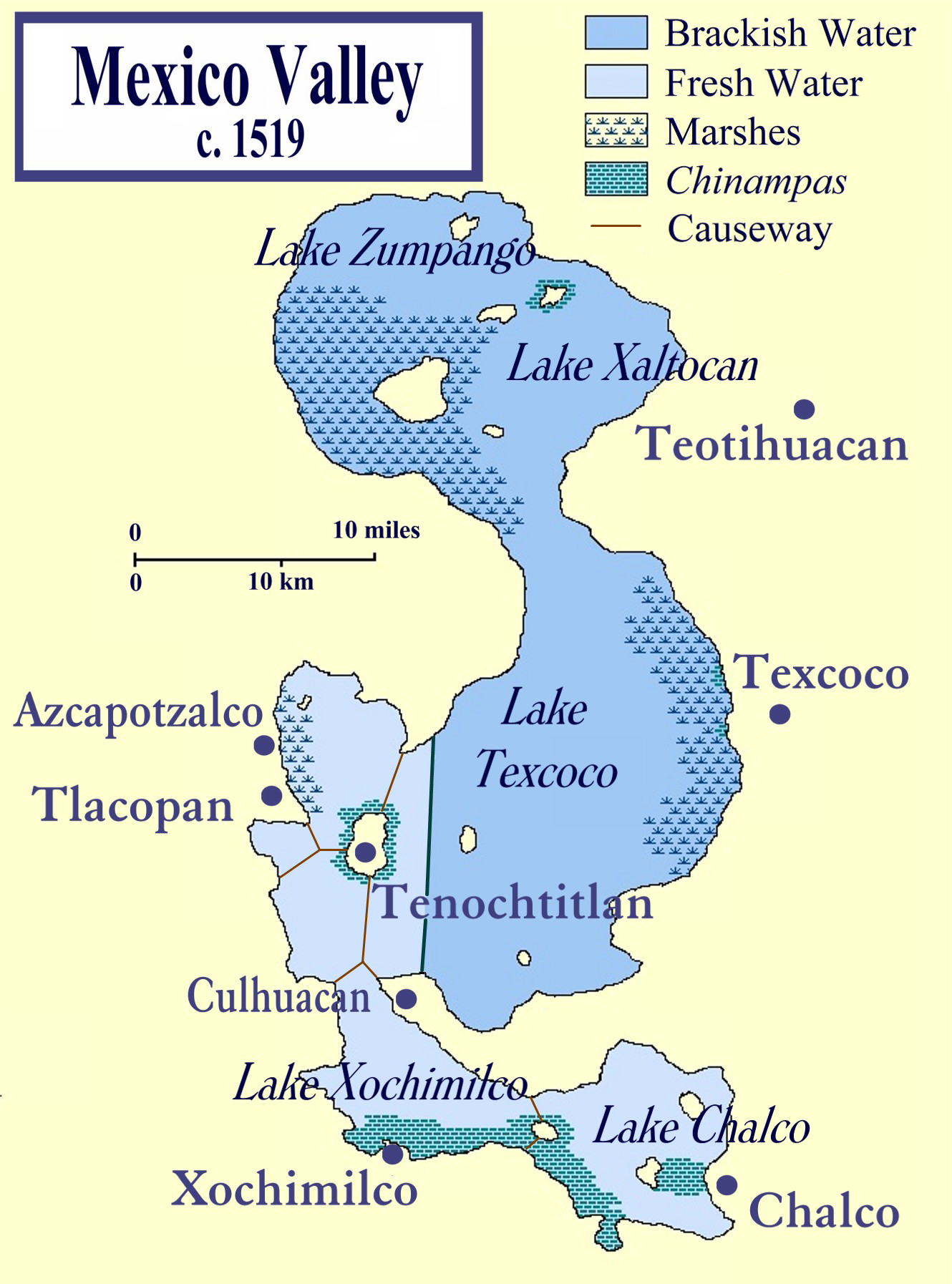
_Map of the Valley of Mexico when the Spanish arrived, showing the chinampas surrounding Tenochtitlán and in Xochimilco, where some have persisted until the present_
The urban Aztecs had a lot of people to feed. They surrounded their island capital of Tenochtitlán with raised planting-beds called [chinampas](https://en.wikipedia.org/wiki/Chinampa) on floating platforms in Lake Texcoco. This intensive gardening technique allowed Aztec farmers to carefully control soil fertility and watering. The Aztecs were so concerned about the quality of the water, they created a dike across the lake that separated the fresh water around their city from the more brackish (salty) water of the main lake to the east; and they drank water brought into the city via an aqueduct from springs in the hills overlooking the lake. The Aztecs supported six people per acre using chinampas in the fifteenth century. By comparison, Chinese intensive rice farming, the most successful agricultural technique known in Europe and Asia, supported only about one person per acre at the same time.
-----
Next: [[4.5 - Inca]]
Back: [[4.3 - Maya Culture]]