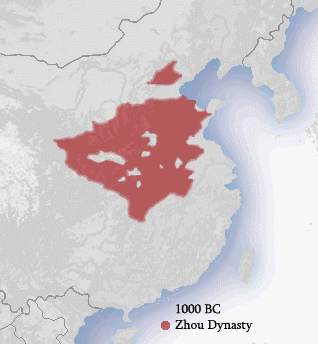
Further east, China's longest-lasting ruling house rose to power in 1046 BCE. The Zhou Dynasty replaced the Shang by invoking the Mandate of Heaven for the first time. This principle would legitimize rulers for nearly three thousand years, asserting that the right to rule was demonstrated by positive outcomes like good harvests and a lack of natural disasters. Zhou control of the North China Plain continued until 256 BCE, and a feudal society developed of landed lords ruling over agrarian serfs. Beginning in the 8th century BCE, a class of scholars called *shi* began to emerge, who became professional civil servants and court administrators. In the three centuries called the Spring and Autumn period, beginning about 722 BCE, there were at least 148 recorded wars. This led to a recognition of the value of educated strategists. One of these was Sun Tzu (544-496 BCE), a philosopher and general whose book, *The Art of War*, is still read today. Some of the ideas in it include: "All warfare is based on deception", and "Supreme excellence consists in breaking the enemy's resistance without fighting." Another *shi* who gained eternal fame was a teacher named Confucius (c. 551-479 BCE), whom we will discuss shortly.
![[Media/1280px-Bamboo_book_-_binding_-_UCR.jpg]]
*A copy of The Art of War written on bamboo.*
-----
Next: [[5.15 - Empire]]
Back: [[5.13 - Chandragupta]]