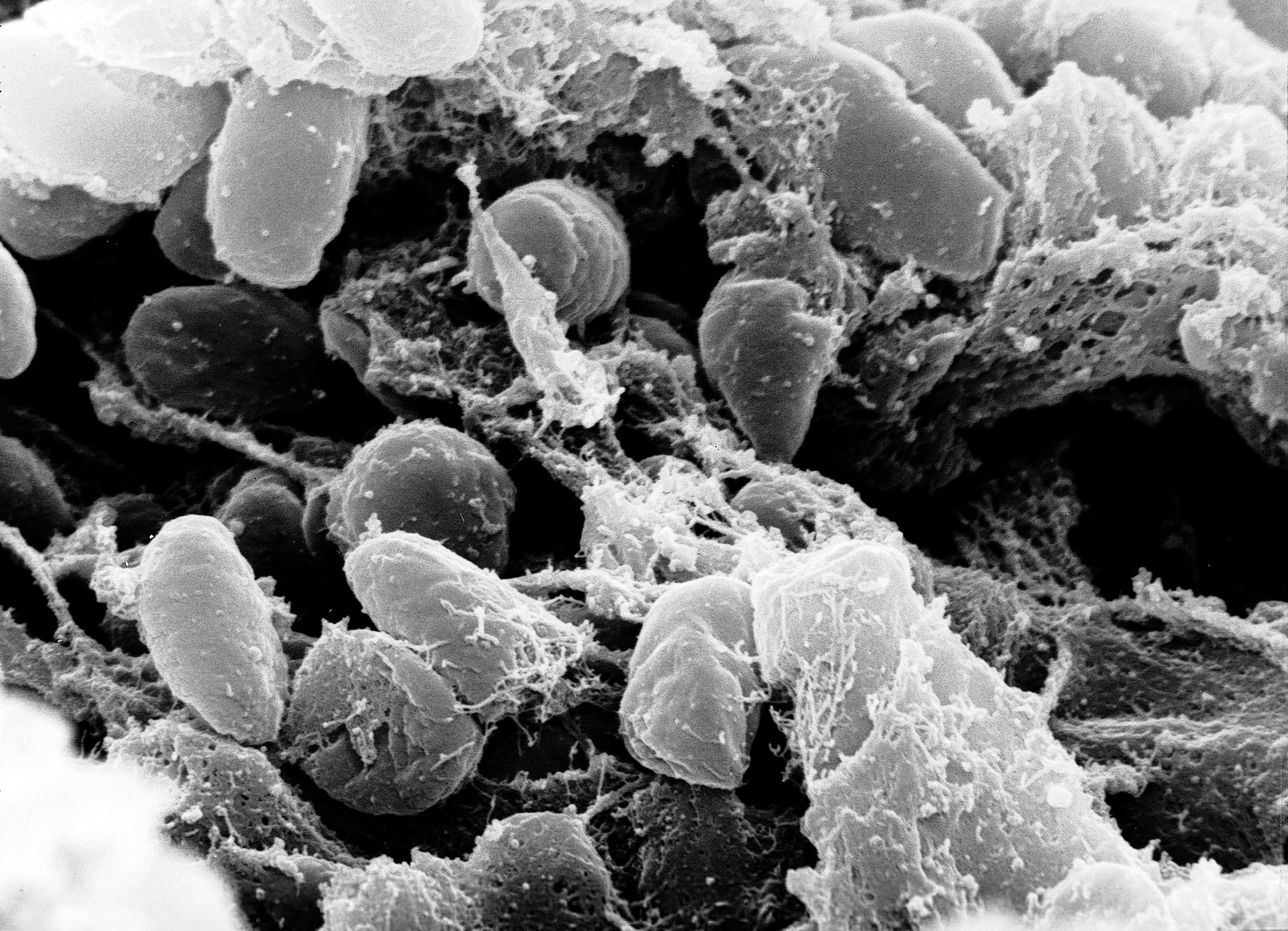
*Electron microscope photo of Yersinia pestis bacteria in the foregut of an infected flea*
During the *Pax Mongolica* of the early 14th century, the Silk Road reached its peak success. The extended Mongol empire controlled all the territory between the Pacific Ocean and the Black Sea. Caravans and official travelers could cover up to 200 miles per day, and for the first time, people from each end of the long trade route, such as the Polos, were able to visit the other endpoint and return home to tell tales of exotic cultures. However, the ease of travel had a disastrous unanticipated consequence when *Yersina pestis*, the bacterium that had caused the plague of Justinian and probably the Yamnaya-era depopulation, rose again to infect humans.
![[Repubblica_di_Genova.png]]
*The Republic of Genoa and its colonies in the Mediterranean and the Black Sea*
The bacteria that had been "hiding out" in rat and gerbil populations of Central Asia spread to humans in Kyrgyzstan, beginning in the 1330s. By 1339 Nestorian Christian gravestones in the region were mentioning "pestilence". Disease spread to caravans and Mongol armies, such as the one that besieged the Genoese trading colony at Kaffa (Crimea) in 1346. When plague began killing Mongols encamped around the city, their corpses were catapulted over the walls to infect the defenders. The Genoese fled by ship, carrying the disease out of the Black Sea into the Mediterranean. By October 1347, plague-infected ships had reached Constantinople and Messina (Sicily).
-----
Next: [[13.5 - Black Death]]
Back: [[13.3 - Kublai Khan]]