The British colonies grew during a time when much of North America, especially the Northeast, engaged in frequent war. Generations of colonial families knew battle firsthand. In the eighteenth century, fighting was seasonal. Armies mobilized in the spring, fought in the summer, and retired to winter quarters in the fall. The British army imposed harsh discipline on its soldiers, who were drawn from the poorer classes, to ensure they did not step out of line during engagements. If they did, their officers would kill them. On the battlefield, armies dressed in bright uniforms to advertise their lack of fear. They stood in tight formation and exchanged volleys of close-range musket-fire with the enemy. In reality, troops often feared their officers more than the enemy.
Most imperial conflicts had both American and European fronts, leaving history with two or more names for each war. For instance, [[King William’s War]] (1688–1697) is also known as the War of the League of Augsburg. In America, the bulk of the fighting in this conflict took place between [[NOTES/New England]] and [[New France]]. [[Queen Anne’s War]] (1702–1713) is also known as the War of Spanish Succession. England fought against both Spain and France over who would inherit the Spanish throne after the last Hapsburg ruler died. In North America, fighting took place in Florida, New England, and New France. In Canada, the French prevailed but lost [[Acadia]] and [[HISTORY Teaching Content/US 1/Topic Index/Newfoundland]]. The English failed to take [[Quebec]], which would have given them complete control of Canada. Queen Anne’s War is best remembered in the United States for the French and Indian raid against [[Deerfield]], Massachusetts, in 1704. A small French force, combined with a native group made up of Catholic Mohawks and Pocumtucs, attacked the frontier village of Deerfield, killing scores and taking 112 prisoners. Among the captives was the seven-year-old daughter of Deerfield’s minister John Williams, named [[Eunice Williams|Eunice]]. She lived with the [[Mohawk|Mohawks]] for years as her family tried to ransom her and became assimilated into the tribe. To the horror of the [[Puritan]] leaders, when she grew up Eunice married a Mohawk man and refused to return to New England.
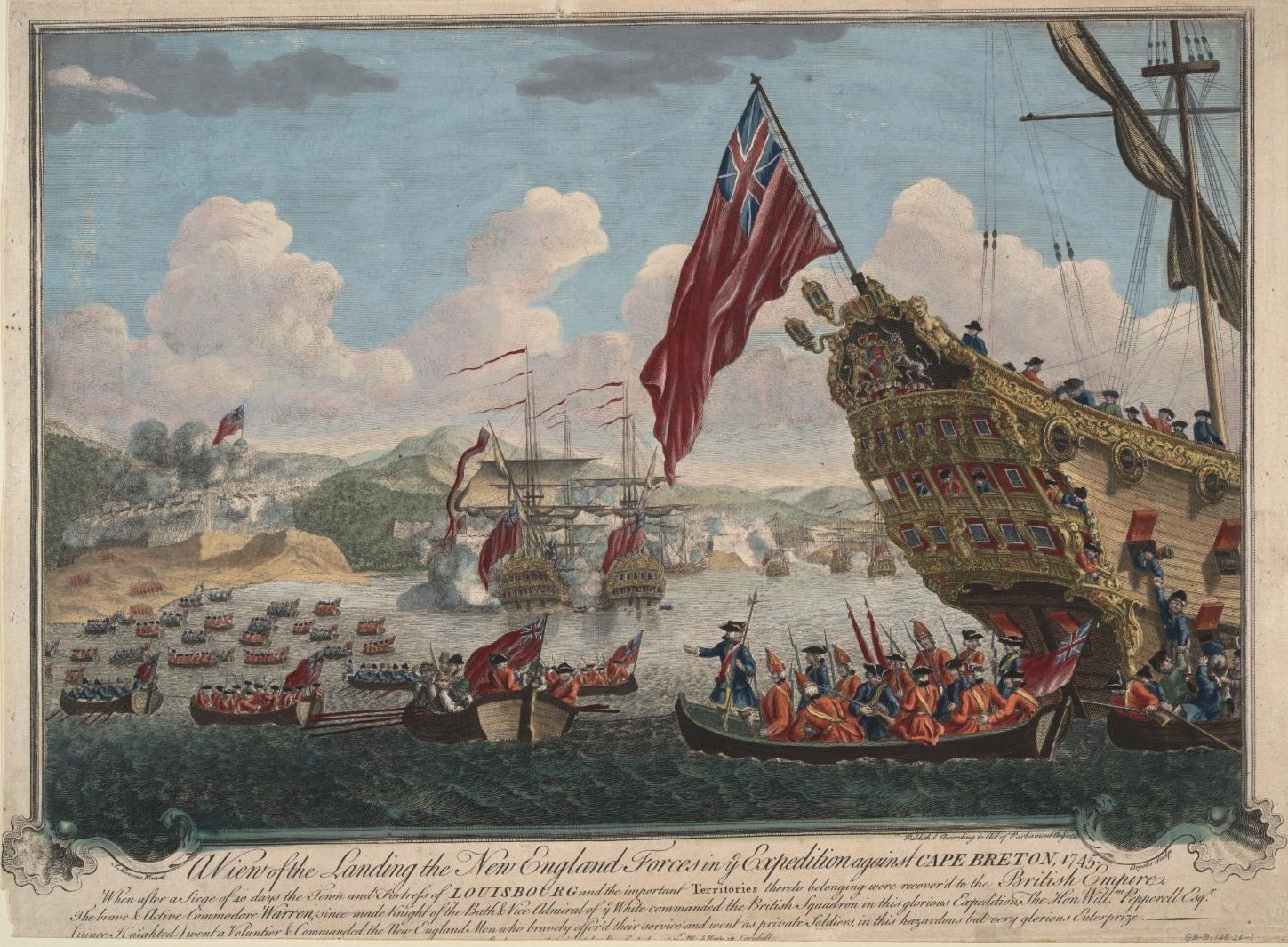
Possession of Georgia and trade with the interior was the focus of the [[War of Jenkins’ Ear]] (1739–1742), a conflict between Britain and Spain over claims to the land occupied by the fledgling Georgia colony between South Carolina and Florida. [[King George’s War]] (1744–1748), known in Europe as the War of Austrian Succession (1740–1748), was fought in the northern colonies and New France. In 1745, the British took the massive French fortress at [[Louisbourg]] on Cape Breton Island, Nova Scotia. However, three years later, under the terms of the Treaty of Aix-la-Chapelle, Britain relinquished control of the fortress to the French.
----
Next: [[6.2 Great Awakening]]