[New Issue · epistularum/hunspell-ja-deinflection (github.com)](https://github.com/epistularum/hunspell-ja-deinflection/issues/new)
[epistularum](https://github.com/epistularum):<https://github.com/epistularum/hunspell-ja-deinflection/issues/1>
[非辞書](非辞書.md) 的英文翻译吧,
# 英语
Suggestions about improve forecast accuracy
Sorry, I am a Chinese student, studying Japanese Language and Literature, so my English is not very good, I hope you can forgive the grammatical errors in this sentence.
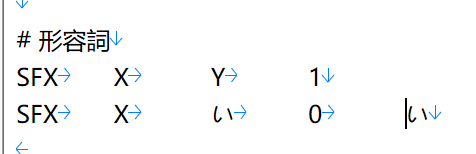
It looks like you left out a lot of details, like `形容詞`:
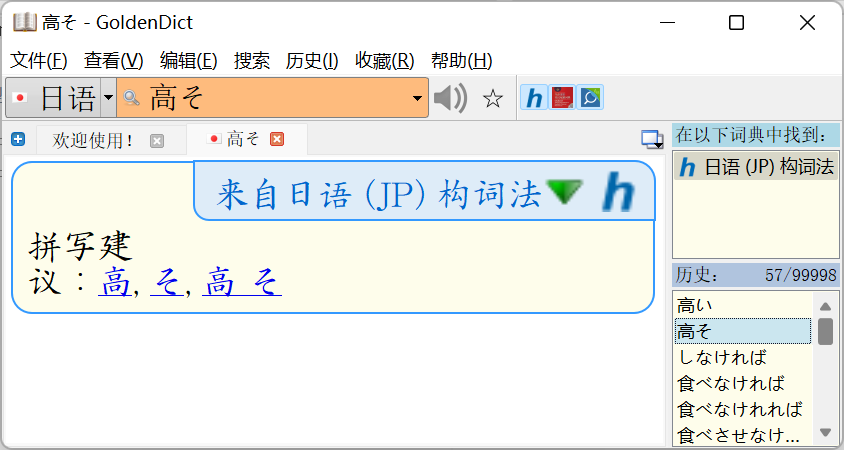
`高そうだ`
According to your point of view, we can find `高い` through `高そ`, but judging from the `.aff` file, you seem to have missed this point (sorry, I[read the hunspell manual,](https://github.com/kindernarr/hunspell_in_depth) but I still don't understand what does the `0` do, so I think you're missing this transformation)
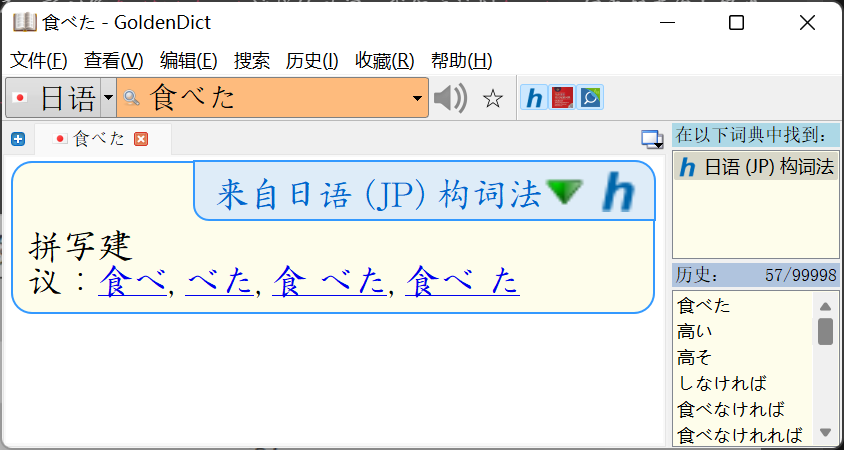
Then it's about `一段動詞`, they all end in る, so a verb like `晩ご飯を食べた`, we should look up `食べた` (if we use `食べ`, we may find `食ぶ`), but it looks like you are ignoring this too:
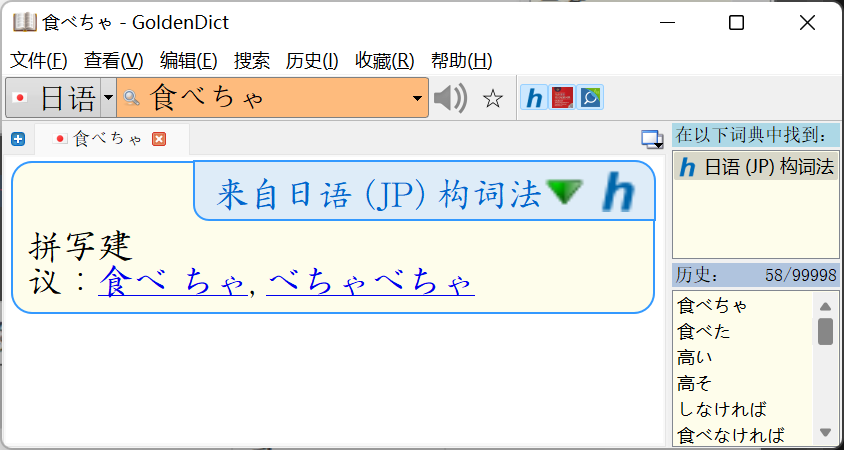
Finally, about `口語`: `すべてのおやつは食べちゃった`, maybe we should use `食べちゃ` instead of `食べち`, because our mouse may not be so accurate.
And There are many other special expressions in Japanese, such as katakana:
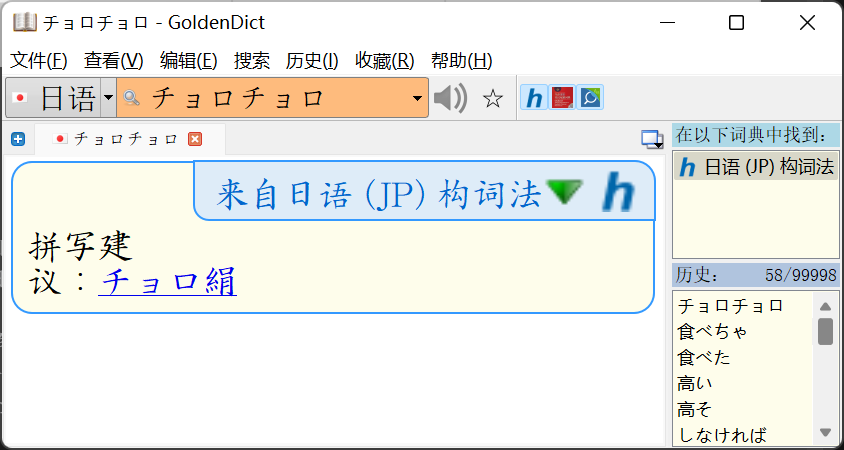
You can refer to this Chinese college student's hunspell file in Github :
[https://github.com/MrCorn0-0/hunspell_ja_JP/](https://github.com/MrCorn0-0/hunspell_ja_JP/)
Although his approach to verbs is not the same as yours, it may help you.
The following are the common word endings in modern Japanese that I have collected: (`五` is a `五段動詞`, and the `一` is a `上一段動詞`, because I am not familiar with `古文`, so it does not include the ancient language)
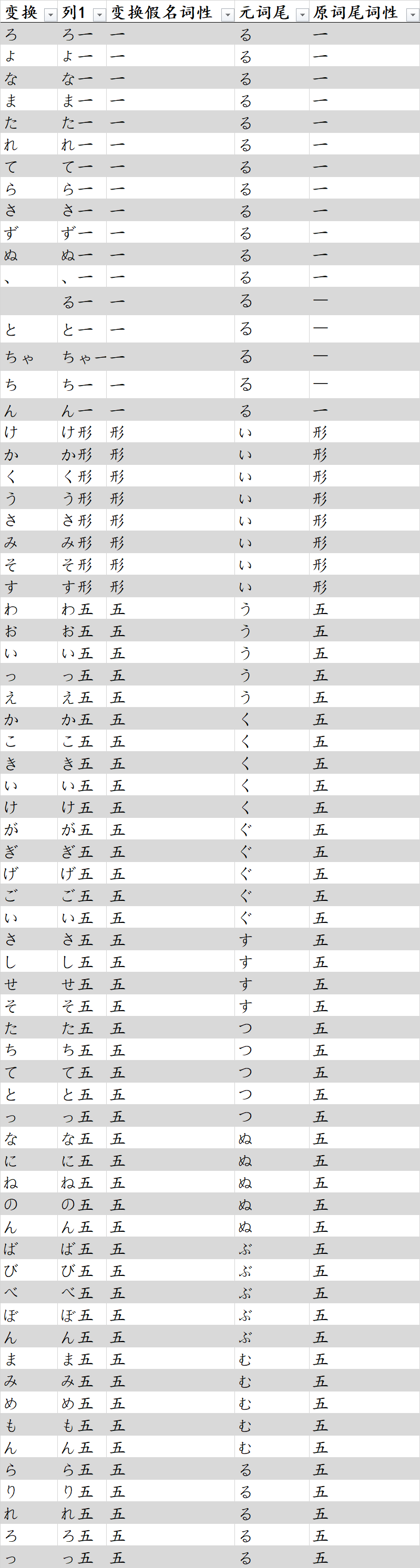
The above data comes from the "NoJishoKei" project. You can find it in FreeMdict's 《[真·哪里不会点哪里_日本語非辞書形辞典_v2 - 日语 - FreeMdict Forum](https://forum.freemdict.com/t/topic/14048)》 (you just need to put it in the content folder like other mdx, when your clipboard is `食べた`, it will give a hyperlink that can jump to `食べる` ).
You can also learn more on GitHub:
[https://github.com/NoHeartPen/NonJishoKei](https://github.com/NoHeartPen/NonJishoKei)
> It is a development project dedicated to providing the best clipboard word search experience, and currently, there is a `日本語非辞書形辞典.mdx` and 2 scripts use Python and JavaScript languages (sorry, The software used in the two scripts are all developed by Chinese, and it may be inconvenient for foreigners to use. I will submit a PR on [Saladict](https://saladict.crimx.com/en/) in the future. Saladict is an online dictionary add-ons like youmichan, but you can use Weblio and Weblio 英和和英辞典)
Finally, it's really nice to meet someone who has the same idea as me, I hope you can achieve the best clipboard word lookup experience on Goldendict with Hunspell :)
# 中文原文
提高预测的准确性
不好意思,我是一名日语专业的中国大学生,我的英语不是很好,希望您能原谅我的语法错误。
看起来您忽略了很多细节,比如`形容詞`:
`高そうだ`
按照您的观点,我们可以通过`高そ`查到`高い`,但是从`.aff`文件来看,您似乎遗漏了这一点(不好意思,我阅读了 hunspell 的手册,还是没有搞懂这里的`0`有什么作用,所以认为您是遗漏了这个变形)


然后是关于`一段動詞`,它们的词尾假名都是る,所以像`晩ご飯を食べた`这样的动词,我们应该划`食べた`(如果用`食べ`,我们可能查到的是`食ぶ`),但看起来您也忽略了这一点:

最后是关于口语的表达:`すべてのおやつは食べちゃった`,也许我们应该用`食べちゃ`,而不是`食べち`,因为我们的鼠标可能没有那么准确。

日语还有很多其他特殊的表达,比如片假名:

您可以参考这位中国大学生的 hunspell 文件:
[https://github.com/MrCorn0-0/hunspell_ja_JP/](https://github.com/MrCorn0-0/hunspell_ja_JP/)
虽然他对于动词的处理原则和您不太一样,但应该对您有所帮助。
以下是我搜集的在现代日语中常见的的词尾变换:(`五`是`五段動詞`,`一`是`上一段動詞`,由于我不太熟悉`古文`,所以并不包含古语)

以上的数据来自《日本語非辞書形辞典》项目,您可以在 FreeMdict《[真·哪里不会点哪里_日本語非辞書形辞典_v2 - 日语 - FreeMdict Forum](https://forum.freemdict.com/t/topic/14048)》(您只需要像使用其他 mdx 放到 content 文件夹即可,它会在您的剪贴板是`食べた`的时候给出一个可以跳转到`食べる`的超链接)。
您也可以在 GitHub 上了解更多信息:
它是一个致力于提供最好的剪贴板查词体验的开发计划,目前已经有一个`日本語非辞書形辞典.mdx`和 2 个分别使用了 Python 和 JavaScript 语言编写的脚本(很抱歉,这 2 个脚本所用的软件都是中国人开发,外国人使用起来会不太方便,后续我会在以[沙拉查词](https://saladict.crimx.com/en/)上提交 PR,它是一个像 youmichan 的在线词典,但您可以使用 Weblio、Weblio 英和和英)
最后,真的很高兴遇到了和我有同样想法的人,希望您能用构词法在 Goldendict 上实现最棒的剪贴板查词体验:)