# Timeline of Computer Music (Simplified)
```text
1940s → Early electronic computing and electronic music
↓
1950s → First computer-generated music & digital synthesis
↓
1960s → Digital sound synthesis & computer composition
↓
1970s → Interactive systems, research centers & advanced synthesis
↓
1980s → Personal computers, MIDI & digital instruments
↓
1990s → Digital audio, sampling & DAWs
↓
2000s → Computer-based music production becomes mainstream
↓
2010s → Mobile music, cloud collaboration & machine learning
↓
2020s → Generative AI & AI-assisted music
```
# 1940s – Early Electronic Music and Computing
### 1. The first electronic computers were developed
The **Electronic Numerical Integrator and Computer (ENIAC)** was one of the first general-purpose electronic computers. It was built using thousands of vacuum tubes and was primarily designed for numerical calculations rather than music.
ENIAC — 1945, University of Pennsylvania

An IBM computer vacuum tube assembly from the 1950's
**Music connection:**
Although ENIAC was not a musical instrument, the development of programmable electronic computers created the technological foundation for later computer-generated music.
### 2. Scientists began experimenting with computers as tools for generating sound

CSIRAC (late 1940s–1950s)
CSIRAC (/ˈsaɪræk/; Commonwealth Scientific and Industrial Research Automatic Computer), developed in Australia, was an early digital computer that was later used to generate music. It is particularly important because it became one of the earliest computers known to play music.
The computer generated musical sequences through programmed instructions that controlled sound-producing hardware.

CSIRAC — developed in the late 1940s and demonstrated playing music in 1951.
### 3. Early electronic music was mainly produced with analog circuits

Hugh Le Caine's electronic instruments, Sackbut in 1948
Canadian physicist and composer **Hugh Le Caine** experimented with electronic sound using oscillators, amplifiers, tape, and other electronic circuits.
His work demonstrated how electronic circuits could create and manipulate sounds without relying on digital computers.
Another important example is the **Ondes Martenot**, an electronic musical instrument developed in 1928 and used extensively during the 1940s.

Ondes Martenot — early electronic musical instrument by Maurice Martenot
# 1950s – Birth of Computer-Generated Music
### 1. 1951 — Ferranti Mark 1

The **Ferranti Mark 1** computer (the world's first commercially available general-purpose electronic computer) in Manchester, UK, was programmed to play a short musical performance. In 1951, programmer Christopher Strachey demonstrated the computer playing tunes including *God Save the King*, *In the Mood*, and *Baa Baa Black Sheep*.

Manchester Mark 1
The music was produced by programming the computer to generate the timing and notes, which were then converted into audible signals.

Ferranti Mark 1 — *God Save the King* (1951)
This demonstrated that a general-purpose computer could be programmed to produce music rather than simply perform mathematical calculations.
### 2. 1957 — Max Mathews and MUSIC I
At Bell Telephone Laboratories, **Max Mathews** developed **MUSIC I** in 1957.
Unlike earlier experiments where computers mainly controlled simple musical tones, MUSIC I was specifically designed to generate sound. It allowed the computer to calculate digital sound waveforms that could then be converted into audio.
The system could generate sounds using numerical descriptions of waveforms and musical parameters.

Max Matthews on MUSIC I - the beginning of computer music - Bell Labs
MUSIC I became the starting point for a family of influential computer-music systems, eventually leading to more sophisticated digital sound synthesis and composition.

**Newman Guttman, _The Silver Scale_ (1957)** — created using **MUSIC I**, the first widely recognized computer music synthesis system, developed by Max Mathews at Bell Labs. _The Silver Scale_ is often cited as one of the earliest pieces of computer-generated music, produced on an **IBM 704** computer and presented in New York City.
# 1960s – Development of Digital Sound Synthesis

Max Mathews with Joan Miller co-author of Music V.
Max Mathews at Bell Labs continued developing the **MUSIC** family of programming languages. These systems allowed computers to generate sounds by mathematically describing waveforms, envelopes, filters, and other sound properties.
### 1. Computers could synthesize tones, instruments, and compositions digitally
With systems such as the MUSIC languages, a computer could mathematically construct an audio waveform rather than simply play back a prerecorded sound. **MUSIC V** became particularly influential because composers and researchers could use it to create complex synthesized sounds and complete musical compositions.
For example, a programmer could specify:
- Frequency → determines the pitch
- Amplitude → determines the volume
- Waveform → determines the basic tone
- Envelope → controls how the sound changes over time
- Harmonics → help create different instrument-like timbres
This meant that computers could create sounds resembling **bells, strings, brass, percussion, and completely new electronic timbres**.

Music IV Example

MUSIC V Example
The MUSIC languages established many of the basic concepts of **computer-based digital sound synthesis** and influenced later synthesizers and music software. This was a major transition from computers simply **playing notes** to computers actually **creating the sound itself**.
### 2. Computer Speech and Music Synthesis
In 1961, an **IBM 704** at Bell Labs was used to synthesize a performance of *Daisy Bell*.
The computer generated the synthesized voice and accompaniment. The demonstration became famous as an early example of **computer speech and music synthesis**. This demonstrated that computers could synthesize not only instrumental tones but also **human-like vocal sounds**.

IBM 704 — *Daisy Bell* (1961)
The experiment was later referenced in the film *2001: A Space Odyssey*, where the HAL 9000 sings *Daisy Bell* as it is being shut down.

Hal 9000 sings Daisy
### 3. John Cage and computer-assisted composition
American composer **John Cage**, together with **Lejaren Hiller**, created *HPSCHD* (1969), a large-scale experimental composition involving computer-generated musical material.
Computers were used to generate musical structures and materials based on programmed procedures. These were combined with live harpsichord performances and other sounds.

*HPSCHD* — John Cage & Lejaren Hiller (1969)
This showed how computers could be used not only to **synthesize sound**, but also to help **generate musical ideas and compositions**.
### 4. Iannis Xenakis and algorithmic composition

*ST/10-1,080262* (1962) by Iannis Xenakis
Greek-French composer **Iannis Xenakis** used mathematical and probabilistic methods to create musical compositions.
He developed computer-based techniques for controlling musical parameters such as pitch, rhythm, and density.
One important example is *ST/10-1,080262* (1962), an early work associated with his use of stochastic/algorithmic techniques.
Xenakis demonstrated that computers and mathematical algorithms could be used as **tools for composing music**, rather than simply producing sounds.
# 1970s – Expansion of Computer Music
### 1. Digital synthesis and computer-assisted composition became more sophisticated
GROOVE was developed at Bell Labs in the early 1970s. GROOVE combined a computer with electronic instruments and controllers, allowing musicians to interact with computer-generated sounds.

GROOVE — interactive computer music
Computer music moved beyond simple experiments toward more sophisticated **sound synthesis, sequencing, and interaction**.
### 2. Universities and research institutions established computer-music laboratories
Universities became important centers for research in computer music, sound synthesis, acoustics, and digital audio. They brought together composers, musicians, engineers, and computer scientists.
As a result, computer music became an established **academic and research field**.
- **University of Illinois at Urbana-Champaign** — computer-assisted composition experiments began in **1955–56**, making Illinois one of the earliest university centers in computer music.
- **Columbia University / Columbia-Princeton Electronic Music Center** — established in **1958** with Rockefeller Foundation support and became an important center for electronic and computer music.
- **Princeton University** — established a computer-music laboratory around **1970**, initially providing digital-to-analog conversion for composers; the work later developed into the Princeton Sound Lab.
- **Stanford University — Center for Computer Research in Music and Acoustics (CCRMA)** — established in the **1970s** and became a major center for computer music, music technology, synthesis, signal processing, and acoustics.
- **MIT — Experimental Music Studio** — established in the **early 1970s** under Barry Vercoe and became an important site for computer-based music synthesis and software development.
- **IRCAM (Institut de Recherche et Coordination Acoustique/Musique), Paris** — founded in **1974** and opened its dedicated facility in **1977** under Pierre Boulez; it became a major international center for computer music and music technology.
- **University of California, San Diego (UCSD)** — developed a significant computer-music research program and studio as computer music expanded through American universities.
- **Eastman School of Music, University of Rochester** — established the **Eastman Computer Music Center**, becoming an important academic center for computer music.
- **Virginia Tech** — established the **Digital Interactive Sound and Intermedia Studio (DISIS)** for research involving interactive sound, music technology, and digital media.
- **University of North Texas** — established the **Center for Experimental and Intermedia**, which became another university-based center for experimental and computer music.
- **New York University (NYU) — Music and Audio Research Laboratory (MARL)** — created around **2009–2010** as the research arm of NYU's Music Technology Program.
# 1980s – Personal Computers and MIDI
## 1. Personal computers made music technology increasingly accessible
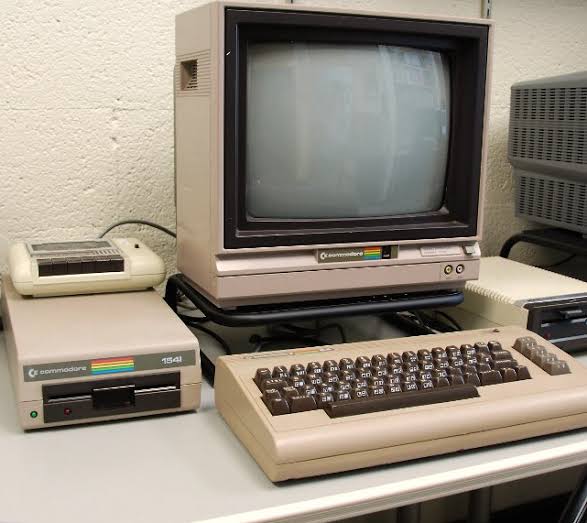
Commodore 64
The **Commodore 64**, released in 1982, became an important computer for home music experimentation. Its built-in **SID (Sound Interface Device)** chip could generate multiple electronic voices and distinctive synthesized sounds.
Musicians and programmers could use software to create melodies, rhythms, and electronic music without needing access to a university computer-music laboratory.

The menu from the 'Ultisynth' program from Quicksilva
Music creation began moving from specialized research institutions into **homes, bedrooms, and personal studios**.
---
## 2. 1983 — MIDI was introduced
In 1983, several companies, including **Roland, Sequential Circuits, Yamaha, Korg, and Kawai**, helped establish the MIDI standard.
**MIDI (Musical Instrument Digital Interface)** provided a common way for electronic musical instruments and computers to exchange musical information. Different manufacturers' instruments could communicate with each other using a common digital language.
MIDI could transmit information such as:
- Note on/off
- Pitch
- Velocity
- Program changes
- Controller information
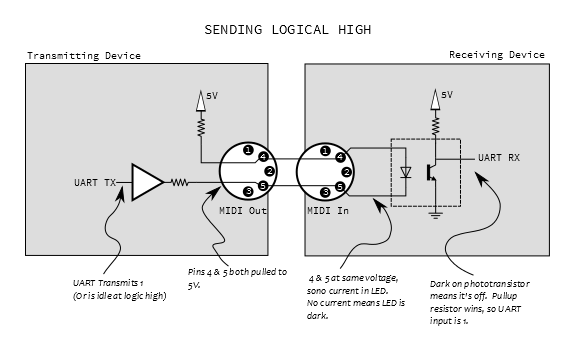
## 3. MIDI allowed instruments, synthesizers, drum machines, and computers to communicate

The **Sequential Circuits Prophet-600** was one of the first commercial synthesizers equipped with MIDI.
MIDI made it possible to connect different pieces of electronic music equipment so that one device could control another. MIDI transformed separate electronic instruments into a **connected music-production system**.
For example:
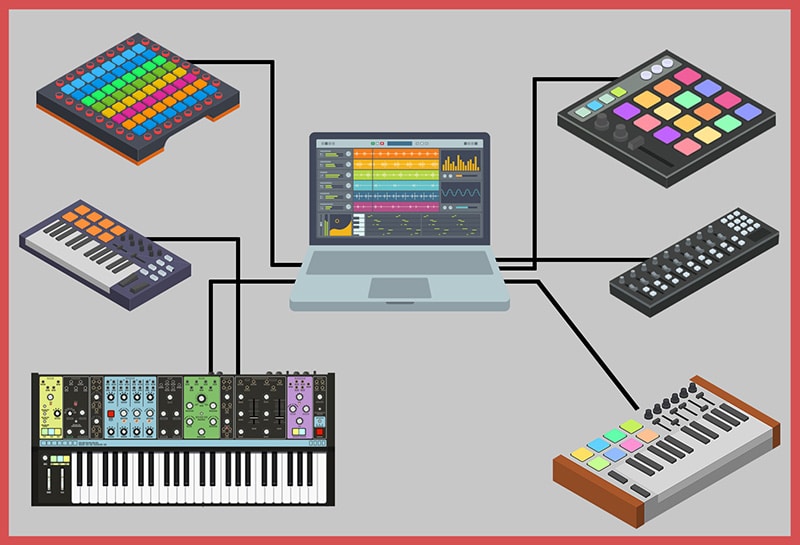
```Example
MIDI Keyboard
↓
Synthesizer
↓
Drum Machine
↓
Computer Sequencer
````
A musician could play a MIDI keyboard while a sequencer recorded the performance and then sent the MIDI information back to the synthesizer.
## 4. Digital samplers and affordable synthesizers became increasingly common
Digital technology made realistic and unusual electronic sounds available to a much larger number of musicians. The **E-mu Emulator II**, released in 1984, was an influential digital sampling keyboard.

Instead of generating every sound from basic waveforms, a sampler could record a real-world sound and play it back at different pitches.
For example:
```text
Real Piano
↓
Digital Recording
↓
Sampler
↓
Play Piano Sound from a Keyboard
```
The **Yamaha DX7**, released in 1983, became one of the most influential digital synthesizers of the 1980s.

It used **FM (Frequency Modulation) synthesis** to create a wide range of sounds, including electric pianos, basses, bells, and other distinctive digital timbres.
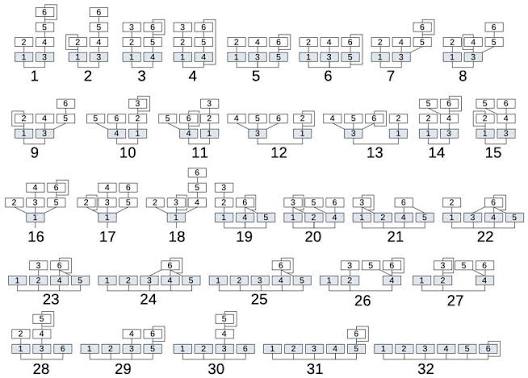
DX-7 Algorithms
## 5. Software-based music composition and sequencing developed rapidly
Software such as **Cubase (Steinberg), Performer (MOTU), and later Logic (Emagic/Apple)** allowed musicians to compose, arrange, and edit music using personal computers. Platforms such as the **Atari ST** also played an important role in the development and adoption of computer-based music production because of their built-in MIDI interfaces.
Early versions of these sequencer programs focused heavily on **MIDI sequencing**.
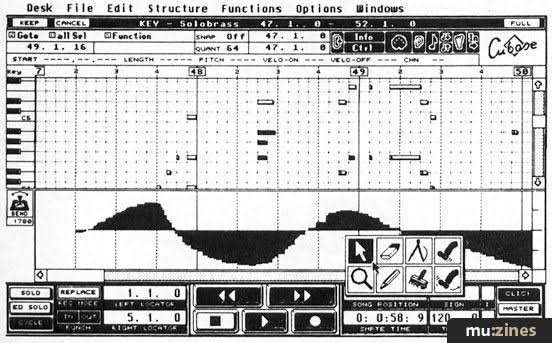
Instead of recording audio directly, musicians could record and edit MIDI events such as:
- **Note-on and note-off events**
- **Pitch**
- **Velocity**
- **Note duration**
- **MIDI channel**
- **Controller information**, such as modulation and sustain
- **Program changes** for selecting instrument sounds
This allowed musicians to compose and revise musical performances non-destructively, often using a **piano-roll or event-list interface**, before audio recording and digital audio editing became central to computer-based music production. The computer increasingly became a **practical music-production tool**, rather than being limited to specialized research applications.
### MIDI Sequencing Workflow
```text
Musician
↓
MIDI Keyboard
↓
Computer Sequencer
↓
MIDI Data
↓
Synthesizer
↓
Audio
```
One additional nuance: the workflow shown is specifically a **MIDI sequencing → external hardware synthesizer → audio** workflow. Later computer music systems increasingly used **software synthesizers**, so you could eventually show:
```text
Musician
↓
MIDI Keyboard
↓
Computer Sequencer
↓
MIDI Data
↓
Software Synthesizer
↓
Digital Audio
```
# 1990s – Digital Audio and Music Software
## 1. Computers became powerful enough for practical digital audio recording and editing
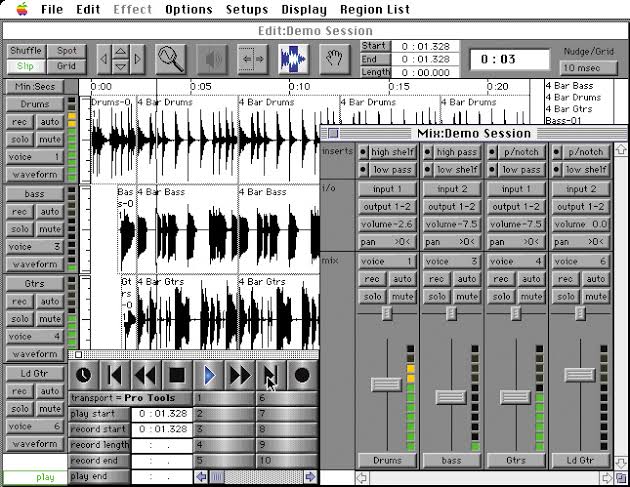
**Pro Tools**, developed by Digidesign, became an important system for recording and editing digital audio.
A DAW (Digital Audio Workstation) could combine:
- MIDI sequencing
- Digital audio recording
- Audio editing
- Mixing
- Effects
- Automation
Unlike earlier MIDI-based systems, digital audio software allowed musicians to record actual sound into a computer and edit it directly. Music production increasingly moved into a **single computer-based environment**.
For example:
```text
Microphone
↓
Audio Interface
↓
Computer
↓
Digital Audio
↓
Edit / Cut / Copy / Process
↓
Final Recording
````
Musicians could cut sections, move recordings, adjust timing, apply effects, and build complete productions digitally. The computer became capable of functioning as a practical **digital recording studio**.
## 2. Sampling became central to hip-hop and electronic music
Hip-hop producers increasingly used sampled recordings as musical building blocks. Sampling turned existing recordings into **raw material for new compositions**.
A producer could take a short section of an existing recording, such as a:
- Drum break
- Bass line
- Vocal phrase
- Piano riff
and manipulate it to create a new musical track.
```text
Original Recording
↓
Sample
↓
Cut / Loop / Pitch / Edit
↓
New Musical Composition
```
_The Bomb! (These Sounds Fall into My Mind)_ by **The Bucketheads** (1995) prominently uses sampled material from Chicago's _Street Player_.

The Bomb! (These Sounds Fall into My Mind) by **The Bucketheads** (1995)

Chicago's Street Player
## 3. Looping became central to techno, house, and electronic dance music
Electronic producers could take short rhythmic or musical phrases and repeat them continuously. This approach became particularly important in **house, techno, trance, and other electronic dance genres**. Digital editing made it easy to **repeat, rearrange, stretch, and manipulate musical material**.
## 4. Digital effects became an important part of music production
Digital audio software made effects such as **reverb, delay, EQ, compression, and distortion** increasingly accessible.
Instead of relying entirely on physical studio hardware, producers could process recorded audio digitally. Sound could be manipulated and shaped **inside the computer**, helping establish the modern software-based production workflow.
# 2000s – Computer Music Becomes Mainstream
## 1. Faster processors and improved audio interfaces made computer-based production accessible to almost everyone
During the 2000s, computers became significantly faster and more affordable. Improvements in **CPU performance, RAM, hard drives, and USB technology** made it possible for musicians to record and produce music using ordinary personal computers.
Affordable audio interfaces allowed microphones, guitars, keyboards, and other instruments to connect directly to computers.
### Example Setup
```text
Microphone
↓
Audio Interface
↓
USB
↓
Computer
↓
DAW
↓
Mix / Edit / Effects
↓
Finished Song
````

A musician could use a desktop or laptop computer with a USB audio interface and a DAW to record an entire song at home. Professional music production was no longer limited to expensive commercial recording studios.
## 2. Software synthesizers and virtual instruments became widely used
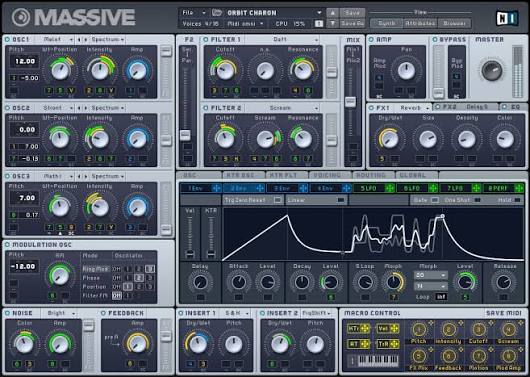
Software synthesizers allowed musicians to create synthesized sounds entirely inside a computer.
One important example was **Native Instruments Massive**, released in 2007. It became especially popular in electronic music because it could create powerful basses, leads, pads, and other synthesized sounds. A computer could now replace many pieces of **hardware synthesizer equipment**.
Instead of using a physical synthesizer:
```text
Traditional Studio
Keyboard
↓
Hardware Synthesizer
↓
Audio
```
musicians could use:
```text
Computer Studio
MIDI Keyboard
↓
Software Synthesizer
↓
DAW
↓
Audio
```
Other examples included:
- **Native Instruments Massive**
- **Sylenth1**
- **Nexus**
- **Arturia software instruments**
## 3. DAWs such as Ableton Live, FL Studio, and Logic Pro became important tools

**Ableton Live**, first released in 2001, was designed for both music production and live performance. It helped blur the boundary between **music production and live performance**.
Its **Session View** made it easy to trigger loops, samples, and musical sections in real time.
```text
Clip 1 → Drum Loop
Clip 2 → Bass
Clip 3 → Synth
Clip 4 → Vocal
↓
Trigger / Arrange
↓
Live Performance
```
**FL Studio**, originally released as **FruityLoops**, became particularly popular among electronic and hip-hop producers.
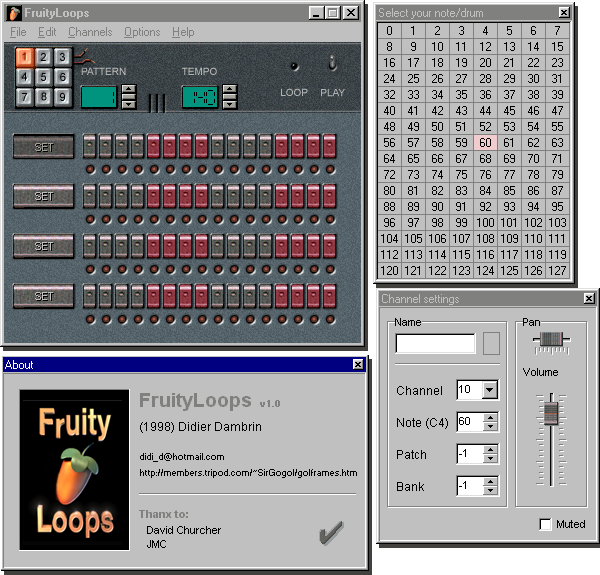
Its **step sequencer** and **piano roll** made it easy to create drum patterns, melodies, and electronic compositions. It made beat-making and electronic production accessible to a large number of home producers.
**Logic Pro** developed into a comprehensive DAW for recording, editing, MIDI sequencing, software instruments, and mixing.

Musicians could create an entire production inside the computer without needing a large collection of external hardware. DAWs became central to both **professional and home music production**.
## 4. Laptop performance and live electronic music became increasingly common
As laptops became more powerful, musicians could perform using software instead of carrying large amounts of hardware.
A performer could use:
```text
Laptop
↓
DAW / Performance Software
↓
Audio Interface
↓
Mixer
↓
Speakers
```
Software could control:
- Loops
- Samples
- Software synthesizers
- Effects
- Drum machines
- Live arrangements
Ableton Live became particularly important for performers who wanted to create and manipulate music in real time using a laptop. The **laptop became a musical instrument** and a complete live-production system.
# 2010s – Mobile, Cloud, and Algorithmic Music

## 1. Smartphones and tablets became capable of sophisticated music production
Apple's **GarageBand** for iPhone and iPad allowed users to create music using virtual instruments, drum machines, loops, microphones, and MIDI controllers.
A musician could create a complete track without needing a traditional desktop computer. Music production became increasingly **portable and accessible**, allowing musicians to create music almost anywhere.
### Example Workflow
```text
iPhone / iPad
↓
GarageBand
↓
Virtual Instruments
+
Drums + Loops
+
Audio Recording
↓
Complete Song
````
## 2. Cloud collaboration and online music-distribution platforms transformed how music was created and shared
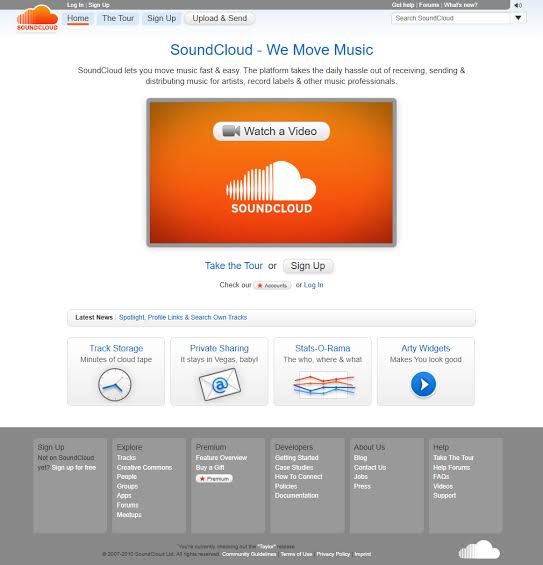_
**SoundCloud** became an important platform for musicians to upload, share, and discover music online.
Independent producers could publish tracks directly to an online audience without relying entirely on traditional record labels. Artists could distribute music **directly to listeners** and build audiences online.

**Splice**, launched in 2013, provided cloud-based access to samples, presets, and music-production resources.
Producers could also use cloud-based collaboration features to work with other musicians and exchange project material. Music production became increasingly **connected through online services**.
```text
Producer A
↓
Cloud
↓
Samples / Projects / Files
↓
Producer B
```
## 3. Generative and algorithmic music systems became more sophisticated

**Google Magenta**, launched as a research project in 2016, explored the use of machine learning to generate music and other creative content.
Researchers developed systems that could generate melodies, rhythms, and musical patterns.
One example is **MusicVAE**, a model that could learn musical patterns and generate new sequences. Computers were increasingly able to **learn patterns from existing music and generate new musical material**.

```text
Musical Data
↓
Machine Learning Model
↓
Learn Musical Patterns
↓
Generate New Material
↓
Melody / Rhythm / Composition
```
## 4. Machine learning was applied to musical composition
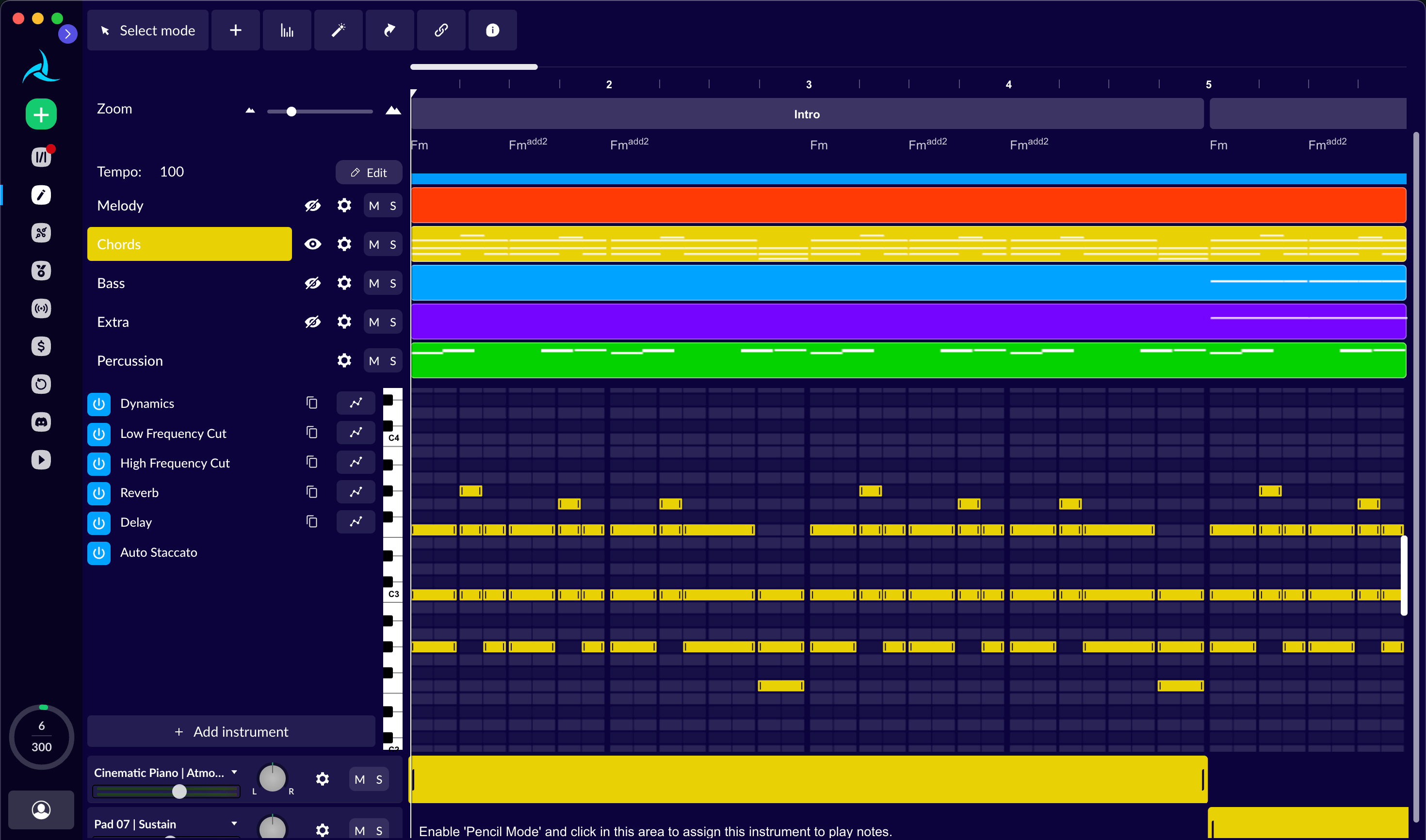
**AIVA (Artificial Intelligence Virtual Artist)** was developed as an AI system for creating musical compositions.
It used machine-learning techniques to generate musical material, particularly for instrumental and cinematic music. Machine learning began moving from experimental research toward **practical composition tools**.
## 5. Machine learning was applied to music recommendation

Streaming platforms such as **Spotify** increasingly used algorithms and machine learning to analyze listening behavior and recommend music to users.
For example, systems could consider:
- Listening history
- Songs frequently played
- Artists a listener follows
- Musical characteristics
- Similar listeners' behavior
This helped produce personalized playlists such as **Discover Weekly**, introduced in 2015. Machine learning became important not only for **creating music**, but also for helping people **discover music**.
```text
Your Listening History
↓
Data Analysis
↓
Machine Learning
↓
Similar Music Patterns
↓
Personalized Recommendations
```
## 6. Machine learning was applied to audio processing

Software companies increasingly incorporated machine-learning-assisted features into audio-production tools.
For example, **iZotope Ozone** introduced intelligent processing features that could analyze audio and help producers make decisions about mastering.
Instead of manually adjusting every parameter, software could analyze the signal and suggest or automatically apply processing. Machine learning began assisting producers with traditionally **technical audio-engineering tasks**.
```text
Audio
↓
Analysis
↓
Algorithm / Machine Learning
↓
Suggested Processing
↓
EQ / Compression / Limiting
↓
Mastered Audio
```
# 2020s – AI and Generative Computer Music
## 1. Artificial intelligence became an increasingly important area of computer music
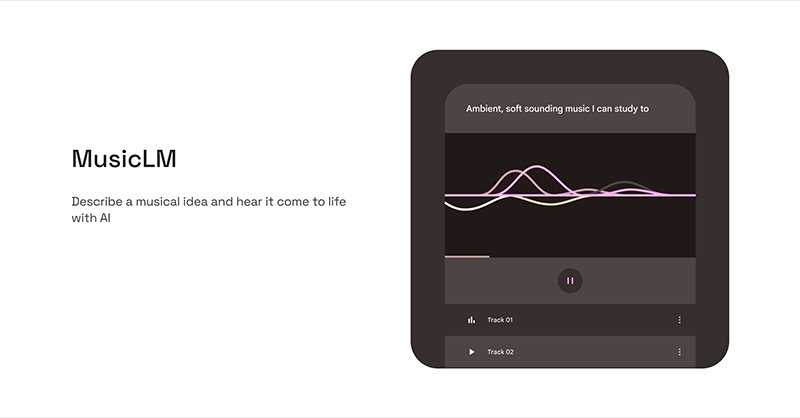
**MusicLM**, introduced by Google Research in 2023, is a generative AI system that can create music from text descriptions.
For example, a user could describe something like:
> "A calm piano melody with soft strings and a cinematic atmosphere."
The system can use the description to generate corresponding musical audio. AI became capable of generating musical material based on human-language descriptions.
```text
Text Description
↓
AI / Machine Learning Model
↓
Learned Musical Patterns
↓
Generated Music
↓
Audio
```
## 2. Machine-learning systems can generate melodies, harmonies, and rhythms
OpenAI's MuseNet was a neural-network-based system capable of generating musical sequences involving different instruments and styles.
It demonstrated how machine-learning models could learn musical relationships such as:
Melody
Harmony
Rhythm
Instrumentation
Musical structure
```
Musical Examples
↓
Neural Network
↓
Learn Patterns
↓
Generate New Notes
↓
Melody + Harmony + Rhythm
```
Machine learning could generate musical structures rather than simply reproducing prerecorded sounds.
## 3. AI can generate vocals
Synthesizer V is a vocal-synthesis software platform that uses AI-based technologies to generate singing voices.
A user can enter:
```
Lyrics
+
Melody
+
Voice
↓
AI Vocal Synthesis
↓
Singing Performance
```
The software can produce vocals with controllable characteristics such as pitch, timing, expression, and pronunciation. Computer-generated music expanded beyond instruments to include increasingly realistic synthetic singing voices.
## 4. AI can generate sound effects and other audio
AudioGen, developed by Meta AI, is a text-to-audio research model that can generate sounds based on textual descriptions.
For example:
```
"Rain falling on a metal roof"
↓
AI Model
↓
Generated Audio
```
Other possible descriptions can involve environmental sounds, mechanical sounds, or other audio events. Generative AI expanded beyond music into general-purpose sound generation.
## 5. AI can generate complete musical arrangements
Suno is an AI music-generation platform that can create complete songs from text prompts.
A user can describe a desired style or concept, and the system can generate elements such as:
Vocals
Lyrics
Instruments
Arrangement
Musical structure
For example:
```
Prompt
"Upbeat electronic song with
female vocals and synth bass"
↓
AI Model
↓
Lyrics + Vocals
+
Instruments + Arrangement
↓
Complete Song
```
AI moved from generating individual musical ideas toward generating complete song productions.
## 6. Neural audio synthesis and text-to-music systems
MusicGen, developed by Meta, is a text-to-music model that can generate music based on textual descriptions.
For example:
```
Text Prompt
↓
"Relaxing acoustic guitar
with a gentle melody"
↓
MusicGen
↓
Generated Audio
```
The system uses neural networks trained on large amounts of musical data to learn relationships between text descriptions and musical characteristics. Natural language became a new way of describing and controlling musical generation.
## 7. AI-assisted composition and production became integrated into commercial music tools
Apple's Logic Pro introduced AI-assisted features such as Drummer, and later Bass Player and Keyboard Player, which can help musicians create accompaniment.
A musician can provide a chord progression or musical context, and the software can generate supporting musical parts.
```
Musician
↓
Chord Progression
↓
AI-Assisted Player
↓
Drums / Bass / Keyboard
↓
Musical Arrangement
```
Another example is Ableton Live's MIDI transformation and generation tools, which assist musicians in developing musical ideas. AI and algorithmic assistance are becoming part of mainstream music-production software, rather than existing only as research projects.