# Detailed Outline: The Sharaku-Kim Hong-do Hypothesis
## SUMMARY
This outline examines the controversial theory that Tōshūsai Sharaku, a mysterious Japanese ukiyo-e artist active in 1794-1795, was actually Kim Hong-do (Danwon), a renowned Korean painter of the Joseon Dynasty. The hypothesis is supported by temporal coincidences, stylistic similarities, and linguistic clues but remains speculative due to lack of concrete historical evidence.
## OUTLINE
### I. Historical Context and Timeline Analysis
- **A. The Mystery of Sharaku's Identity**
- Sudden appearance in May 1794 with no prior artistic record
- Prolific output of 140+ kabuki actor portraits in 10 months
- Complete disappearance by early 1795 without explanation
- Various theories: Noh actor Saito Jurobei, Hokusai, or unknown artist
- **B. Kim Hong-do's Career and Absence**
- Established court painter (1745-c.1806) known for genre paintings
- Documented absence from official duties as Yunpoong Hyungam in 1794
- Coincidental timing with Sharaku's entire active period
- Possible diplomatic mission theory under King Jeongjo's orders
- **C. Cultural Exchange Framework**
- Late 18th century Korea-Japan diplomatic relations
- Tong Sin Sa (Korean diplomatic missions) as cultural conduits
- Japan's sakoku policy and limited foreign contact
- Precedent for artistic exchange despite political tensions
### II. Artistic Commonalities and Techniques
- **A. Shared Genre Focus**
- **Sharaku's Approach**: Okubi-e portraits emphasizing psychological realism over idealized beauty
- **Kim Hong-do's Method**: Genre paintings capturing daily life with vivid realism
- **Common Thread**: Both artists prioritized human emotion and character over conventional beauty standards
- **B. Technical Similarities**
- **Brushstroke Analysis**: Distinctive upward curve signature in both artists' work
- **Color Palette**: Bold use of whites, blues, and greens with minimal calligraphy
- **Compositional Style**: Dynamic, crowded scenes with emphasis on movement and expression
- **Medium Mastery**: Both demonstrated exceptional skill in their respective techniques
- **C. Iconographic Peculiarities**
- **Six-toed Buddha Depictions**: Rare artistic choice shared by both artists
- **Religious Iconography**: Unconventional religious representations
- **Cultural Symbols**: Integration of East Asian Buddhist and Confucian elements
- **Personal Signatures**: Potential identification markers in artistic choices
### III. Linguistic and Cultural Evidence
- **A. Poetry and Language Analysis**
- Sharaku's Japanese poems incomprehensible to native speakers
- Poems gain meaning when translated into 18th-century Korean
- Presence of "danwon" (Kim Hong-do's pen name) in Sharaku's verse
- Linguistic patterns suggesting Korean cultural background
- **B. Cultural References and Themes**
- East Asian artistic traditions shared between Korea and Japan
- Confucian and Buddhist influences in both artists' work
- Social commentary through artistic expression
- Cross-cultural understanding of theatrical and daily life subjects
- **C. Artistic Identity and Pseudonyms**
- Use of artistic names as common practice in East Asia
- Sharaku as potential pseudonym for cross-cultural artistic mission
- Kim Hong-do's versatility enabling adaptation to Japanese ukiyo-e style
- Strategic identity concealment for diplomatic or artistic purposes
### IV. Supporting Evidence and Arguments
- **A. Temporal Coincidences**
- Exact 10-month overlap between Sharaku's career and Kim Hong-do's absence
- No other documented artistic activity for Kim Hong-do during this period
- Timing aligns with potential diplomatic mission requirements
- Historical precedent for artist-diplomats in East Asian culture
- **B. Stylistic Convergence**
- Shared emphasis on capturing human essence over superficial beauty
- Similar approaches to color, composition, and subject matter
- Technical proficiency suggesting extensive artistic training
- Adaptation skills necessary for cross-cultural artistic expression
- **C. Circumstantial Evidence**
- Lack of alternative explanations for Kim Hong-do's 1794 absence
- Sharaku's sophisticated understanding of Japanese culture and theater
- Quality and quantity of work suggesting established artistic expertise
- Cultural knowledge evident in accurate kabuki actor portrayals
### V. Counterarguments and Critical Analysis
- **A. Historical Documentation Issues**
- No official records of Kim Hong-do's travel to Japan
- Absence of diplomatic mission documentation
- Lack of contemporary accounts linking the two artists
- Speculation based on circumstantial rather than direct evidence
- **B. Alternative Explanations**
- **Saito Jurobei Theory**: Noh actor with documented contemporary existence
- **Hokusai Connection**: Established artist with technical capability
- **Unknown Artist Theory**: Possibility of genuinely mysterious figure
- **Collective Pseudonym**: Multiple artists working under single name
- **C. Methodological Concerns**
- **Artistic Trend Analysis**: Similarities may reflect broader East Asian artistic movements
- **Confirmation Bias**: Selective interpretation of evidence to support hypothesis
- **Nationalistic Motivations**: Korean cultural pride influencing interpretation
- **Academic Skepticism**: Insufficient evidence for scholarly consensus
### VI. Cultural and Historical Significance
- **A. Cross-Cultural Artistic Exchange**
- Demonstration of pre-modern East Asian cultural fluidity
- Challenge to nationalist narratives of isolated artistic traditions
- Evidence of sophisticated cultural diplomacy through art
- Model for understanding regional artistic development
- **B. Individual Artistic Legacies**
- **Sharaku's Impact**: Influence on European Impressionism and modern art
- **Kim Hong-do's Legacy**: Foundation of Korean genre painting tradition
- **Combined Significance**: Representation of East Asian artistic excellence
- **Modern Relevance**: Inspiration for contemporary cross-cultural artistic dialogue
- **C. Scholarly and Popular Reception**
- Korean media popularization vs. Japanese academic skepticism
- Nationalist tensions influencing scholarly interpretation
- Popular cultural impact through television and literature
- Academic debate methodology and evidence standards
### VII. Contemporary Implications and Future Research
- **A. Modern Art Historical Methodology**
- Integration of cross-cultural perspectives in art history
- Importance of primary source documentation
- Balancing speculation with evidence-based analysis
- Technology's role in artistic authentication and analysis
- **B. Cultural Bridge-Building**
- Art as diplomatic and cultural exchange medium
- Overcoming historical tensions through shared artistic appreciation
- Educational value of cross-cultural artistic studies
- Contemporary relevance for Korea-Japan relations
- **C. Research Directions**
- **Archaeological Evidence**: Potential discovery of travel documentation
- **Technological Analysis**: Advanced analysis of artistic techniques and materials
- **Comparative Studies**: Broader examination of East Asian artistic exchange
- **Interdisciplinary Approaches**: Combining art history, linguistics, and cultural studies
### VIII. Conclusion and Assessment
- **A. Hypothesis Evaluation**
- Compelling circumstantial evidence with significant gaps
- Artistic similarities requiring further investigation
- Cultural plausibility within historical context
- Scholarly caution warranted despite popular appeal
- **B. Broader Implications**
- Importance of questioning established art historical narratives
- Value of cross-cultural artistic analysis
- Recognition of pre-modern East Asian cultural sophistication
- Encouragement of continued scholarly investigation
- **C. Final Synthesis**
- Appreciation for both artists' individual contributions
- Understanding of shared East Asian artistic traditions
- Acceptance of historical mysteries as part of cultural heritage
- Emphasis on artistic excellence regardless of nationality
## TABLE
|**Aspect**|**Sharaku (1794-1795)**|**Kim Hong-do (1745-c.1806)**|**Comparison**|
|---|---|---|---|
|**Active Period**|10 months (May 1794-early 1795)|Lifetime career with 1794 absence|Exact temporal overlap|
|**Artistic Focus**|Kabuki actor portraits (okubi-e)|Genre paintings of daily life|Both emphasized human character|
|**Technique**|Woodblock printing (ukiyo-e)|Traditional Korean painting|Different media, similar approach|
|**Style**|Psychological realism, satirical|Vivid realism, humorous|Shared emphasis on emotion|
|**Subjects**|Theatrical performers|Common people, court scenes|Both captured human experience|
|**Cultural Impact**|Influenced European Impressionism|Foundation of Korean genre painting|Lasting artistic legacies|
|**Historical Records**|Minimal documentation|Well-documented except 1794|Mysterious gap coincidence|
|**Artistic Training**|Unknown background|Court painter education|Skilled craftsmanship evident|
## Significance
This hypothesis represents a fascinating intersection of **art history, cultural exchange, and national identity** in East Asia. Whether proven or not, it demonstrates the **interconnectedness of artistic traditions** across political boundaries and challenges us to consider **art as a universal language** that transcends cultural divisions. The debate itself has become culturally significant, encouraging deeper examination of **pre-modern East Asian cultural sophistication** and the **fluidity of artistic identity** in historical contexts.
The investigation highlights the importance of **rigorous scholarly methodology** while appreciating the **romantic appeal of historical mysteries**. It serves as a case study in how **circumstantial evidence** can generate compelling theories that enrich our understanding of cultural exchange, even when definitive proof remains elusive.
Most importantly, both artists' legacies remind us that **great art captures the human condition** regardless of national origin, and that **cultural appreciation** can serve as a bridge between historically divided peoples.
# Multiple Perspectives Analysis: The Sharaku-Kim Hong-do Hypothesis
## 1. Interesting
The **cross-cultural detective story** aspect makes this hypothesis captivating - a renowned Korean court painter potentially adopting a Japanese pseudonym to create revolutionary kabuki portraits in secret. The **temporal precision** is striking: Kim Hong-do's documented absence from court duties aligns exactly with Sharaku's entire 10-month career, creating a perfect historical puzzle piece.
What's particularly fascinating is the **artistic code-switching** required - if true, Kim Hong-do would have had to master not just a foreign artistic medium (ukiyo-e woodblock printing) but also deeply understand Japanese theatrical culture to capture kabuki actors with such psychological intensity. The **linguistic breadcrumbs** in Sharaku's poetry, readable only in Korean and containing "danwon" (Kim's pen name), add layers of intrigue that feel almost deliberately planted.
The **cultural audacity** of the proposed mission - a Korean artist infiltrating Japanese artistic circles during a period of restricted cultural exchange - represents a remarkable form of **artistic diplomacy** that challenges our understanding of 18th-century East Asian cultural isolation.
## 2. Surprising
Most shocking is the **linguistic evidence** - Sharaku's Japanese poems being incomprehensible to native speakers but making perfect sense when translated into 18th-century Korean. This suggests either extraordinary coincidence or deliberate cultural encoding that would represent unprecedented **artistic espionage**.
The **technical mastery leap** is astounding - Kim Hong-do would have had to instantly master ukiyo-e woodblock printing, a highly specialized technique requiring years of training, while simultaneously developing deep insights into Japanese kabuki theater. The **volume of output** (140+ prints in 10 months) suggests either superhuman productivity or a pre-existing artistic infrastructure.
The **six-toed Buddha** iconography shared between both artists is bizarrely specific - this unusual religious representation appearing in both Korean and Japanese contexts suggests either a **shared personal quirk** or a broader East Asian artistic trend that historians have missed.
Perhaps most surprising is how this theory has remained **academically marginalized** despite compelling circumstantial evidence, revealing the **nationalistic blind spots** in art historical scholarship.
## 3. Significant
This hypothesis **revolutionizes our understanding** of pre-modern East Asian cultural exchange, suggesting far more sophisticated cross-cultural artistic dialogue than previously recognized. If proven, it would demonstrate that **artistic identity was more fluid** than modern nationalist narratives suggest, with artists capable of complete cultural code-switching.
The **methodological implications** are profound - it challenges art historians to look beyond national boundaries and consider **transnational artistic networks** that operated despite political restrictions. The theory forces reconsideration of how we **authenticate artistic identity** and the reliability of historical documentation.
Culturally, it represents potential **reconciliation between Korean and Japanese artistic heritage**, suggesting shared rather than competing traditions. The hypothesis **democratizes artistic genius** by showing how cultural exchange enhanced rather than diminished individual creativity.
The **academic reception disparity** (Korean enthusiasm vs. Japanese skepticism) reveals how **contemporary politics shape historical interpretation**, making this as much about modern cultural relations as 18th-century art history.
## 4. Genius
The **artistic versatility** demonstrated by both figures (whether same person or not) represents extraordinary creative intelligence. Sharaku's ability to **revolutionize ukiyo-e** by introducing psychological realism over idealized beauty shows genius-level artistic innovation that transformed an entire medium.
Kim Hong-do's **genre painting mastery** - capturing the essence of Joseon daily life with humor and humanity - demonstrates parallel genius in making ordinary subjects extraordinary. Both artists shared the **revolutionary insight** that art should capture inner character rather than surface appearance.
The **hypothesis itself** shows intellectual genius - connecting two seemingly unrelated artistic figures through subtle clues like brushstroke patterns and iconographic choices. This **forensic art history** approach represents innovative scholarly thinking.
If true, the **strategic cultural navigation** required - maintaining artistic authenticity while operating across cultural boundaries - would represent genius-level **cultural intelligence** and adaptability that transcends artistic skill alone.
## 5. Problematic
The **evidence foundation** is fundamentally weak - built on circumstantial coincidences, stylistic similarities, and linguistic interpretations that could have alternative explanations. The **absence of primary documentation** makes this more speculation than scholarship, potentially **misleading public understanding** of historical methodology.
The **nationalistic undertones** are concerning - Korean media promoting the theory for cultural pride while Japanese scholars dismiss it for similar reasons, turning **academic inquiry into cultural competition**. This politicization undermines objective historical analysis.
The **confirmation bias** is evident - cherry-picking evidence that supports the theory while ignoring contradictory information. The **six-toed Buddha** similarity could reflect broader artistic trends rather than personal signature, and **brushstroke patterns** might be common technical approaches rather than individual markers.
The theory risks **overshadowing individual achievements** - both artists' legacies become entangled in identity speculation rather than celebrated for their distinct contributions to their respective cultures.
## 6. Assumption/Underlying
The hypothesis assumes **extensive cultural exchange** was possible in 1794 despite documented restrictions on Korean-Japanese interaction. It presupposes that **artistic mastery** is easily transferable across cultures and mediums without considering the deep cultural knowledge required for authentic artistic expression.
There's an underlying assumption that **stylistic similarities** indicate shared authorship rather than common East Asian artistic traditions influenced by Chinese painting. The theory assumes **diplomatic secrecy** was sophisticated enough to completely erase historical documentation while maintaining perfect timing coordination.
The **linguistic evidence** assumes deliberate encoding rather than coincidental pattern matching or translation errors. It presupposes that **artistic identity** was fluid enough to allow complete cultural transformation while maintaining personal artistic signatures.
Most fundamentally, it assumes that **historical mysteries** must have exotic explanations rather than mundane ones - that Sharaku must be someone famous rather than simply an unknown artist who appeared and disappeared.
## 7. Frame/Lens
The hypothesis is viewed through a **cross-cultural lens** that emphasizes East Asian artistic unity over national boundaries, framing art as a **universal language** that transcends political divisions. This perspective values **cultural exchange** as enhancing rather than diluting artistic authenticity.
The **nationalist lens** creates competing interpretations - Korean sources frame it as **cultural reclamation** while Japanese sources view it as **cultural appropriation**. This dual framing reveals how **contemporary politics** shape historical interpretation.
The **romantic lens** emphasizes mystery and intrigue, framing the hypothesis as an **artistic detective story** rather than rigorous historical analysis. This perspective prioritizes **narrative appeal** over evidential standards.
The **academic lens** demands **primary source documentation** and peer review, framing the theory as **interesting speculation** requiring further investigation rather than established fact.
## 8. Duality
The central duality lies between **unity and division** - the hypothesis suggests artistic unity between Korean and Japanese traditions while simultaneously dividing scholarly and popular opinion along national lines.
There's a **realism versus idealism** duality - both artists balanced accurate observation with artistic interpretation, capturing human essence while maintaining distinct stylistic approaches. Their work embodies **individual versus universal** themes - highly personal artistic vision expressing universal human experiences.
The **evidence versus speculation** duality reflects the **tension between romantic appeal and scholarly rigor** - compelling circumstantial evidence that falls short of academic proof standards.
The **historical versus contemporary** duality shows how **past cultural exchange** becomes entangled with **present political relationships**, making objective historical analysis nearly impossible.
## 9. Key Insight
The profound insight is that **artistic excellence transcends national boundaries** - whether Sharaku was Kim Hong-do or not, both artists shared a **humanistic vision** that captured the essence of their subjects with unprecedented psychological depth.
The hypothesis reveals that **cultural identity in art** is more complex than modern nationalist narratives suggest - artists in pre-modern East Asia may have operated within **transnational creative networks** that allowed for sophisticated cultural code-switching.
The **methodological insight** is that art historical authentication requires **interdisciplinary approaches** combining stylistic analysis, historical documentation, linguistic evidence, and cultural context rather than relying on single sources of evidence.
Most importantly, the debate demonstrates that **historical mysteries** can be valuable regardless of resolution - they encourage **critical thinking**, **cross-cultural dialogue**, and **appreciation for artistic complexity** that enriches our understanding of human creativity.
## 10. Highest Perspective
From the highest perspective, this hypothesis represents **humanity's eternal quest** to understand creative genius and cultural connection across boundaries. Art serves as a **universal language** that speaks to shared human experiences regardless of national origin or historical period.
The debate transcends art history to address fundamental questions about **identity, authenticity, and cultural ownership** in an interconnected world. It reminds us that **great art belongs to all humanity** while respecting the specific cultural contexts that created it.
The hypothesis embodies the **beauty of uncertainty** - some historical mysteries may be more valuable unsolved, continuing to inspire investigation, dialogue, and appreciation for the complexity of human creativity.
Ultimately, it demonstrates that **cultural appreciation** can serve as a bridge between historically divided peoples, suggesting that **artistic legacy** is more important than **artistic nationality** in understanding human creative achievement.
## 11. Takeaway Message
The Sharaku-Kim Hong-do hypothesis, whether proven or not, reminds us that **art transcends boundaries** - political, cultural, and temporal. Both artists, regardless of their relationship, created works that continue to speak to universal human experiences across centuries and cultures.
Rather than focusing on resolving the mystery, we should appreciate how their combined legacy **enriches our understanding** of 18th-century East Asian cultural sophistication and the **power of artistic exchange** to create extraordinary creative works.
The debate itself demonstrates that **historical inquiry** should remain open to surprising possibilities while maintaining **rigorous evidential standards**. It encourages us to **question established narratives** and consider how **cultural exchange** has always been a driving force in human creativity.
Most importantly, both artists' works remind us that **great art captures the human condition** with honesty, humor, and profound insight - qualities that unite rather than divide us across cultural boundaries. Their legacy encourages continued **cross-cultural dialogue** and **appreciation for artistic excellence** regardless of national origin.
2025-0715 grok recall [video](https://www.youtube.com/watch?v=8SJrr5To1Zg)
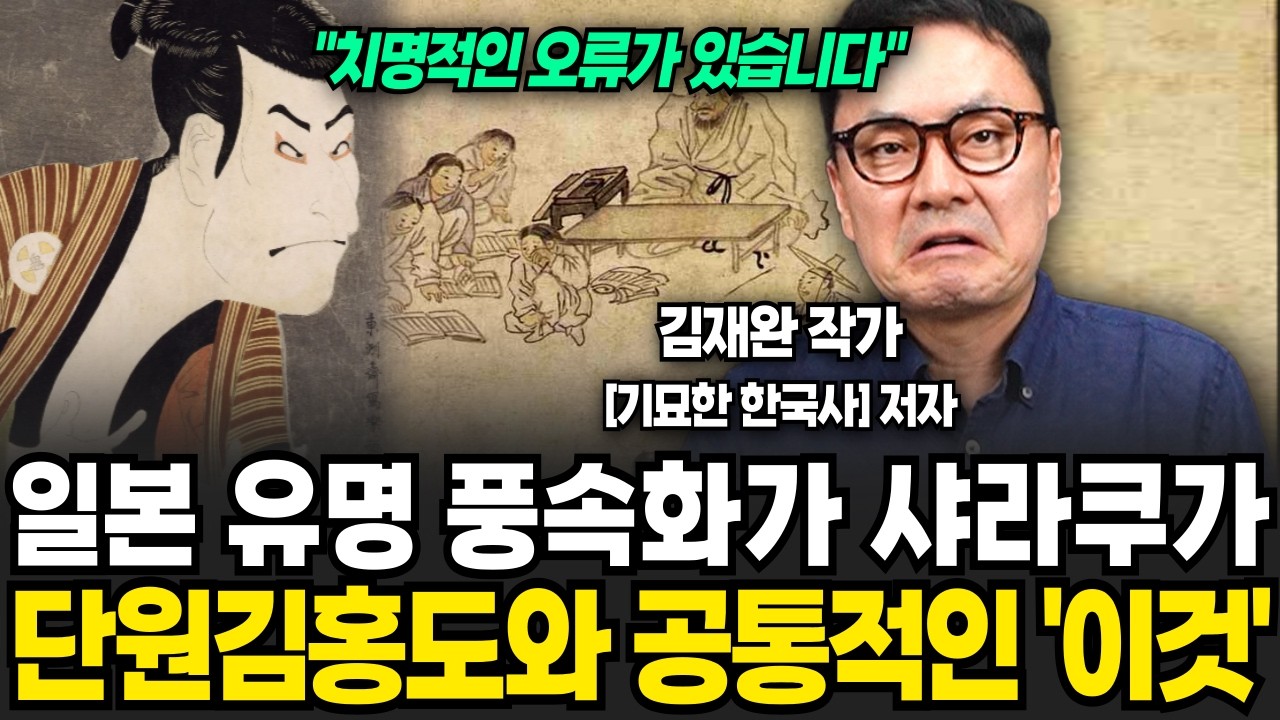
<div><br class="Apple-interchange-newline">일본 유명 풍속화가 샤라쿠가 단원김홍도와 공통적인 '이것' (김재완 작가 / 1부)</div>
---
Detailed summary
## Introduction to Kim Hong-do and the controversy surrounding Sharaku
- The reason Sharaku disappeared from Japanese history after one year is claimed to be because he was actually Kim Mong-do, a Korean painter, and there are fatal errors found in the paintings of Kim Mong-do and Tarako that are not just similar styles or homage, but rather identical [(00:00:07)](https://www.youtube.com/watch?v=8SJrr5To1Zg&t=7s).
- Kim Jae-wan, a history storyteller, introduces himself and his recent book, "Gi-myo-han Korean History", which was released in June, and mentions his other works, including "Jjira-shi Korean History" and "Jjira-shi World History" [(00:00:32)](https://www.youtube.com/watch?v=8SJrr5To1Zg&t=32s).
- The story of Kim Hong-do, also known as Danwon, being the best painter of the Joseon Dynasty and allegedly being a spy, is discussed, and it is confirmed that Kim Hong-do was indeed a spy, with historical records showing his partnership with King Jeongjo [(00:01:10)](https://www.youtube.com/watch?v=8SJrr5To1Zg&t=70s).
- The Hongjaejeonseo book, a cultural heritage of Seoul, contains records of the long-standing partnership between King Jeongjo and Danwon Kim Hong-do, and Kim Hong-do's background and career as a painter are explored, including his recruitment as a royal court painter at a young age [(00:01:43)](https://www.youtube.com/watch?v=8SJrr5To1Zg&t=103s).
## Kim Hong-do's background and career as a royal court painter
- King Jeongjo's reform policies and his establishment of the Gyujanggak, a royal library and research institute, are mentioned, and how Danwon Kim Hong-do was recruited to work under the Gyujanggak, which had a special task force for painting, and how this led to his meeting with King Jeongjo [(00:02:44)](https://www.youtube.com/watch?v=8SJrr5To1Zg&t=164s).
- The importance of paintings as a means of gathering information in the absence of photography during the Joseon Dynasty is highlighted, and Danwon Kim Hong-do's role in creating paintings of Japan's geography and terrain for military purposes is discussed, with historical records showing that he traveled to Tsushima Island to create maps [(00:03:17)](https://www.youtube.com/watch?v=8SJrr5To1Zg&t=197s).
- The timing of Danwon Kim Hong-do's mission to create maps of Japan is noted to be in 1788, a politically sensitive period, and the historical context of the Imjin War and Japan's invasion of Korea is mentioned, with Danwon Kim Hong-do's mission taking place two years after the Japanese invasion [(00:04:03)](https://www.youtube.com/watch?v=8SJrr5To1Zg&t=243s).
- The king of Joseon suddenly changed his stance and rejected the visit of the Joseon communication officer, which led to the destruction of Kim Mong-do, an artist who not only depicted the beautiful scenery and people of Korea but also played the role of a spy, reporting on foreign trends [(00:04:52)](https://www.youtube.com/watch?v=8SJrr5To1Zg&t=292s).
## Kim Hong-do's role as a spy and his missions to Japan and China
- Kim Hong-do, also known as Kim Mong-do, was sent to Japan and China, including the Qing dynasty, as a secret agent, and his main task was to observe and report on the situation in these countries [(00:05:24)](https://www.youtube.com/watch?v=8SJrr5To1Zg&t=324s).
- Kim Mong-do's trip to the Qing dynasty is recorded in the "Ilseongnok", a book that documents the daily activities and speeches of the Joseon kings from the 36th year of King Yeongjo's reign to about 150 years later, which was designated as a national treasure in 1973 and a UNESCO World Heritage Record [(00:05:58)](https://www.youtube.com/watch?v=8SJrr5To1Zg&t=358s).
- The reason why Kim Mong-do was included in the diplomatic mission to China is not clear, but it is believed that the Qing dynasty was introducing Western culture, including Western painting techniques, at that time, and Kim Mong-do learned these techniques, such as perspective and chiaroscuro, and applied them to his paintings [(00:07:10)](https://www.youtube.com/watch?v=8SJrr5To1Zg&t=430s).
- Kim Mong-do's paintings, which used Western techniques, were confirmed through the book "Ilgo", which contains writings about celebrities during the Yeongjo era, and his works include not only genre paintings but also landscapes and other types of paintings [(00:07:51)](https://www.youtube.com/watch?v=8SJrr5To1Zg&t=471s).
## Kim Hong-do's artistic style and techniques
- Despite Kim Mong-do's versatility as an artist, he is mostly known for his genre paintings, and the reason for this is not entirely clear, but it may be related to the fact that the king directly appointed him as a painter, bypassing the usual bureaucratic channels [(00:08:56)](https://www.youtube.com/watch?v=8SJrr5To1Zg&t=536s).
- The king had a strong affection for his people and wanted to understand their daily lives, so he ordered his artists to paint scenes of ordinary people's lives, which is why Kim Hong-do's paintings are so detailed and realistic, showing scenes such as farming, marketplaces, and festivals [(00:09:13)](https://www.youtube.com/watch?v=8SJrr5To1Zg&t=553s).
- Kim Hong-do was not only skilled at painting scenes of everyday life but also excelled at painting Buddhist murals, and one of his notable works is the unique and unconventional mural at Yongjusa Temple in Hwaseong, which features unusual techniques and styles [(00:10:13)](https://www.youtube.com/watch?v=8SJrr5To1Zg&t=613s).
- The king's 20th anniversary on the throne and his father's 60th birthday were commemorated with a large-scale performance, and Kim Hong-do was in charge of documenting this event, known as the Hwaseong Fortress Tour, through his paintings [(00:10:38)](https://www.youtube.com/watch?v=8SJrr5To1Zg&t=638s).
- The Hwaseong Fortress Tour paintings are valuable historical records that depict the king's procession and the people's daily lives, showcasing the fashion and culture of the time [(00:11:07)](https://www.youtube.com/watch?v=8SJrr5To1Zg&t=667s).
## The theory that Sharaku was Kim Hong-do
- A Japanese ukiyo-e artist named Toshusai Sharaku is known for his unique and influential works, and there is a theory that he may have been inspired by Kim Hong-do, which was discussed in a 1998 book and even featured in a Japanese TV special and a planned film [(00:11:23)](https://www.youtube.com/watch?v=8SJrr5To1Zg&t=683s).
- Sharaku was an enigmatic figure who was active for only 10 months in 1794 and left behind a significant body of work that was not recognized in Japan until much later, but his paintings had a profound influence on Western artists such as Van Gogh and other Impressionists [(00:12:07)](https://www.youtube.com/watch?v=8SJrr5To1Zg&t=727s).
- Sharaku's paintings primarily focused on depicting kabuki actors, who were popular entertainers in Japan, known for their elaborate costumes and performances, and his works were not widely appreciated during his lifetime but are now highly valued for their unique style and historical significance [(00:12:45)](https://www.youtube.com/watch?v=8SJrr5To1Zg&t=765s).
- Sharaku, a Japanese painter, was dissatisfied with the way his contemporaries depicted actors, as they were often portrayed in an overly flattering manner, and instead, he sought to capture their true essence, which led to his work being disliked by the actors, and his style was considered too ahead of its time [(00:13:34)](https://www.youtube.com/watch?v=8SJrr5To1Zg&t=814s).
- Sharaku's sudden disappearance from the Japanese art scene after only one year of activity in 1794 has sparked various theories, including the claim that he was actually Kim Mong-do, a Korean painter who was sent to Japan as a spy by King Jeongjo, and that his disappearance was due to his true identity being discovered [(00:14:06)](https://www.youtube.com/watch?v=8SJrr5To1Zg&t=846s).
- Kim Hong-do, a Korean painter, is believed by some to have been active in Japan during the same period as Sharaku, and it is suggested that he may have been sent to Japan in secret, as there are no records of his activities in Korea during that time, and a record of him being sent to a remote area in Korea, where he would have had ample time to travel to Japan and create art [(00:14:24)](https://www.youtube.com/watch?v=8SJrr5To1Zg&t=864s).
- A comparison of Kim Hong-do and Sharaku's artwork reveals a common, critical error in their depiction of human hands and feet, which is unlikely to be a coincidence, given the rarity of such mistakes among skilled artists of the time [(00:15:43)](https://www.youtube.com/watch?v=8SJrr5To1Zg&t=943s).
- Sharaku's paintings contain a hidden code, which, when deciphered, appears to point to Kim Hong-do's identity and his connection to Korea, with the characters "dongju" referring to a house in the east, likely Japan, and "san" being a name similar to Kim Hong-do's, and the final character "rak" being derived from the name of a location in Korea where Kim Hong-do was known to have worked [(00:17:16)](https://www.youtube.com/watch?v=8SJrr5To1Zg&t=1036s).
- The combination of these factors, including the similarity in artistic style and the presence of a hidden code, has led some to speculate that Sharaku and Kim Hong-do may have been the same person, or at least, that there was a significant connection between the two artists [(00:17:41)](https://www.youtube.com/watch?v=8SJrr5To1Zg&t=1061s).
# Is Tōshūsai Sharaku and Kim Hong-do (Danwon) the same person?
## I. Introduction
A. **Overview of the Artists**
1. **Tōshūsai Sharaku**: A Japanese ukiyo-e artist active in 1794–1795, known for his expressive portraits of kabuki actors, producing over 140 woodblock prints in a brief 10-month period before mysteriously disappearing.[](https://www.tnm.jp/modules/r_free_page/index.php?id=451&lang=en)[](https://www.emakubo.com/journal/sharaku-kabuki)
2. **Kim Hong-do (Danwon)**: A prominent Korean painter of the Joseon Dynasty (1745–c. 1806), celebrated for his genre paintings depicting daily life, landscapes, and court scenes, known for vibrant realism and versatility.[](https://en.wikipedia.org/wiki/Korean_painting)[](https://www.pinterest.com/niyaniyaso/kim-hong-do-danwon/)[](https://teaching-korea.co.uk/object/genre-paintings/)
B. **Purpose of the Outline**
3. To explore the hypothesis that Sharaku and Kim Hong-do may be the same person, as proposed by some scholars and popularized in media.[](https://wayneoutthere.com/2015/01/20/was-japanese-artist-sharaku-actually-korean-kim-hong-do/)[](https://press.kookmin.ac.kr/news/articleView.html?idxno=100560)
4. To identify commonalities in their artistic styles, techniques, and historical contexts, while addressing the controversy and lack of definitive evidence.
## II. Historical Context and Career Overlap
A. **Timeline Coincidence**
1. **Sharaku’s Active Period**: Appeared suddenly in May 1794, produced a prolific output of kabuki actor portraits, and vanished after 10 months (by early 1795).[](https://www.tnm.jp/modules/r_free_page/index.php?id=451&lang=en)
2. **Kim Hong-do’s Latency Period**: During 1794, Kim Hong-do, a court painter, was reportedly absent from his official duties as Yunpoong Hyungam, coinciding with Sharaku’s active period in Japan.[](https://press.kookmin.ac.kr/news/articleView.html?idxno=100560)
3. **Hypothesis**: Some scholars suggest Kim Hong-do traveled to Japan under the pseudonym Sharaku, possibly on a diplomatic mission ordered by King Jeongjo, though no official records confirm this.[](https://press.kookmin.ac.kr/news/articleView.html?idxno=100560)
B. **Cultural Exchange Context**
4. **Korea-Japan Interactions**: During the late 18th century, Korean diplomatic missions (Tong Sin Sa) traveled to Japan, providing opportunities for cultural exchange, though no evidence confirms Kim Hong-do’s participation.[](https://press.kookmin.ac.kr/news/articleView.html?idxno=100560)
5. **Artistic Influence**: Both regions shared East Asian artistic traditions, with influences from Chinese painting, which may explain stylistic similarities.[](https://en.wikipedia.org/wiki/Korean_painting)
## III. Artistic Commonalities
A. **Genre Painting Focus**
1. **Sharaku’s Ukiyo-e Portraits**:
- Specialized in okubi-e (large-head portraits) of kabuki actors, emphasizing exaggerated expressions and psychological realism over idealized beauty.[](https://press.kookmin.ac.kr/news/articleView.html?idxno=100560)
- His works captured the inner character of actors, often with sharp, satirical features, which were not always popular with contemporary audiences.[](https://press.kookmin.ac.kr/news/articleView.html?idxno=100560)
2. **Kim Hong-do’s Genre Paintings**:
- Renowned for his “Album of Genre Paintings” depicting the daily lives of commoners, artisans, and workers in the Joseon Dynasty, with a focus on realistic, lively scenes.[](https://www.artsy.net/artwork/kim-hong-do-danweonpungsogdoceob-genre-painting-album-by-danwon)[](https://teaching-korea.co.uk/object/genre-paintings/)
- His paintings, such as “Dancing Boy” (1780), reflect humor, movement, and a vivid portrayal of ordinary people, akin to Dutch genre painting.[](https://www.pinterest.com/niyaniyaso/kim-hong-do-danwon/)
3. **Shared Emphasis**: Both artists focused on portraying human activities and emotions, capturing the essence of their subjects’ lives, whether performers (Sharaku) or common folk (Kim Hong-do).[](https://en.wikipedia.org/wiki/Korean_painting)
B. **Painting Techniques**
4. **Brushstroke Similarity**:
- Kim Hong-do’s signature brushstroke featured an upward curve at the end, a distinctive trait also observed in Sharaku’s woodblock prints, suggesting a possible shared technique.[](https://wayneoutthere.com/2015/01/20/was-japanese-artist-sharaku-actually-korean-kim-hong-do/)[](http://wayneoutthere.com/was-japanese-artist-sharaku-actually-korean-kim-hong-do/)
- This stylistic marker is considered a key piece of evidence by proponents of the shared identity hypothesis.
5. **Use of Color and Composition**:
- Kim Hong-do employed a palette of whites, blues, and greens, with minimal calligraphy, focusing on vibrant, crowded scenes.[](https://en.wikipedia.org/wiki/Korean_painting)
- Sharaku’s ukiyo-e prints used bold colors and dynamic compositions, often with mica backgrounds to enhance vibrancy, aligning with Kim’s colorful realism.[](https://www.emakubo.com/journal/sharaku-kabuki)
C. **Unusual Iconography**:
6. **Six-Toed Buddha Depictions**:
- Both artists reportedly painted Buddha figures with six toes, an uncommon feature in religious iconography, cited as a significant point of similarity.[](https://wayneoutthere.com/2015/01/20/was-japanese-artist-sharaku-actually-korean-kim-hong-do/)[](https://press.kookmin.ac.kr/news/articleView.html?idxno=100560)
- This quirk is argued to be a personal signature, though it may reflect a broader artistic trend of the era rather than a definitive link.[](https://press.kookmin.ac.kr/news/articleView.html?idxno=100560)
## IV. Linguistic and Cultural Evidence
A. **Poetry and Language**:
1. **Sharaku’s Poems**:
- Some of Sharaku’s Japanese poems were reportedly incomprehensible to Japanese readers but made sense when translated into the Korean language of the time, suggesting a Korean influence.[](https://wayneoutthere.com/2015/01/20/was-japanese-artist-sharaku-actually-korean-kim-hong-do/)[](http://wayneoutthere.com/was-japanese-artist-sharaku-actually-korean-kim-hong-do/)
- One poem allegedly contains the word “danwon,” Kim Hong-do’s pen name, interpreted as a possible self-reference.[](https://wayneoutthere.com/2015/01/20/was-japanese-artist-sharaku-actually-korean-kim-hong-do/)
2. **Cultural Implications**:
- The presence of Korean linguistic elements in Sharaku’s work supports the hypothesis of a Korean artist operating in Japan, though this remains speculative without primary sources.[](https://press.kookmin.ac.kr/news/articleView.html?idxno=100560)
B. **Artistic Identity and Pseudonym**:
3. **Sharaku’s Mysterious Identity**: Scholars debate whether Sharaku was a pseudonym for another artist, with theories suggesting he could be a Noh actor (Saito Jurobei) or even Hokusai, but the Kim Hong-do hypothesis adds a cross-cultural dimension.[](https://www.tnm.jp/modules/r_free_page/index.php?id=451&lang=en)[](https://www.emakubo.com/journal/sharaku-kabuki)
4. **Kim Hong-do’s Versatility**: As a court painter skilled in multiple genres (landscapes, portraits, religious themes), Kim could plausibly have adapted to ukiyo-e, a popular Japanese style, during a brief stint in Japan.[](https://teaching-korea.co.uk/object/genre-paintings/)
## V. Critical Analysis of the Hypothesis
A. **Supporting Arguments**:
1. **Temporal Alignment**: The exact overlap of Sharaku’s 10-month career and Kim Hong-do’s absence from court duties is a compelling coincidence.[](https://wayneoutthere.com/2015/01/20/was-japanese-artist-sharaku-actually-korean-kim-hong-do/)[](https://press.kookmin.ac.kr/news/articleView.html?idxno=100560)
2. **Stylistic Similarities**: Shared brushstroke techniques and iconographic quirks (e.g., six-toed Buddhas) suggest a possible connection.[](https://wayneoutthere.com/2015/01/20/was-japanese-artist-sharaku-actually-korean-kim-hong-do/)
3. **Cultural References**: The Korean elements in Sharaku’s poetry bolster the case for a Korean artist’s influence.[](http://wayneoutthere.com/was-japanese-artist-sharaku-actually-korean-kim-hong-do/)
B. **Counterarguments**:
4. **Lack of Historical Records**: No official documents confirm Kim Hong-do’s travel to Japan or participation in diplomatic missions, undermining the hypothesis.[](https://press.kookmin.ac.kr/news/articleView.html?idxno=100560)
5. **Artistic Trends**: Similarities in style (e.g., six-toed Buddhas) may reflect regional artistic trends rather than a single artist’s work.[](https://press.kookmin.ac.kr/news/articleView.html?idxno=100560)
6. **Alternative Theories**: Sharaku’s identity is also linked to Saito Jurobei (a Noh actor) or Hokusai, with stronger evidence for the former due to contemporary records.‥web:7⁊[](https://www.tnm.jp/modules/r_free_page/index.php?id=451&lang=en)
C. **Scholarly Consensus**:
7. The hypothesis is popular in Korean media (e.g., MBC’s “Surprise” program) but controversial in Japan, where it is often dismissed due to national pride and lack of evidence.[](https://press.kookmin.ac.kr/news/articleView.html?idxno=100560)
8. Experts like Jin Jung-hyun (Seoul National University Museum) argue that the theory, as presented in works like Lee Young-hee’s “The Other Sharaku,” is speculative and should be treated as fiction.[](https://press.kookmin.ac.kr/news/articleView.html?idxno=100560)
## VI. Cultural and Historical Significance
A. **Impact on Art History**:
1. **Sharaku’s Legacy**: His ukiyo-e portraits influenced European Impressionists (e.g., Manet, Monet, Van Gogh) and remain iconic in Japanese art for their psychological depth.[](https://press.kookmin.ac.kr/news/articleView.html?idxno=100560)
2. **Kim Hong-do’s Legacy**: His genre paintings are celebrated as National Treasures in Korea, embodying the spirit of Joseon society and influencing modern Korean art.[](https://teaching-korea.co.uk/object/genre-paintings/)
B. **Cross-Cultural Dialogue**:
3. The hypothesis highlights historical cultural exchanges between Korea and Japan, despite modern nationalistic tensions.[](https://wayneoutthere.com/2015/01/20/was-japanese-artist-sharaku-actually-korean-kim-hong-do/)
4. It underscores the fluidity of artistic identity in East Asia, where shared traditions and travel could blur national boundaries.
C. **Modern Relevance**:
5. The debate has been popularized through media in both Korea and Japan, sparking public interest in the mystery of Sharaku’s identity.[](https://wayneoutthere.com/2015/01/20/was-japanese-artist-sharaku-actually-korean-kim-hong-do/)[](https://press.kookmin.ac.kr/news/articleView.html?idxno=100560)
6. It serves as a case study in how art can bridge or complicate national narratives, encouraging critical examination of historical claims.
## VII. Conclusion
A. **Summary of Commonalities**:
1. Both artists excelled in genre painting, capturing the lives and emotions of their subjects (kabuki actors for Sharaku, commoners for Kim Hong-do).
2. Shared stylistic traits include distinctive brushstrokes and unusual iconography (e.g., six-toed Buddhas).
3. Temporal overlap and linguistic clues in Sharaku’s poetry fuel speculation of a shared identity.
B. **Evaluation of the Hypothesis**:
4. While intriguing, the theory lacks conclusive evidence and is considered speculative by many scholars.
5. Commonalities may reflect broader East Asian artistic trends rather than a single artist’s work.
C. **Final Thoughts**:
6. The Sharaku-Kim Hong-do hypothesis enriches our understanding of both artists by highlighting their shared artistic spirit and the possibility of cross-cultural exchange.
7. Further research, including primary documents or new archaeological findings, is needed to resolve the mystery definitively.
---
# Comments
---
### 1. Interesting
- **What’s Interesting**: The hypothesis that Sharaku, a mysterious Japanese ukiyo-e artist, could be Kim Hong-do, a renowned Korean painter, is intriguing due to its cross-cultural implications. The idea that a Korean court painter might have traveled to Japan in 1794, adopted a pseudonym, and produced over 140 woodblock prints in just 10 months is a compelling narrative. The overlap of their timelines—Kim Hong-do’s absence from Joseon court duties coinciding with Sharaku’s brief career—adds a detective-like mystery to art history. Additionally, the shared stylistic elements, such as the distinctive upward-curving brushstroke and the rare depiction of six-toed Buddhas, make this a fascinating case of potential artistic convergence across borders.
---
### 2. Surprising
- **What’s Surprising**: The most surprising aspect is the linguistic clue in Sharaku’s poetry, which reportedly makes sense only when translated into Korean and includes the term “danwon” (Kim Hong-do’s pen name). This suggests a deliberate cultural signature, which is unexpected given the distinct national contexts of 18th-century Japan and Korea. Equally surprising is the notion that Kim Hong-do, a versatile but court-bound painter, could have mastered the ukiyo-e woodblock printing technique—a highly specialized medium—without any documented training or presence in Japan. The absence of historical records for such a significant journey adds to the shock value of the hypothesis.
---
### 3. Significant
- **What’s Significant**: The hypothesis underscores the potential for cultural exchange between Korea and Japan during the late 18th century, a period often viewed as relatively insular due to Japan’s sakoku (closed-country) policy and Korea’s strict Joseon governance. If true, it would highlight the mobility of artists and ideas across East Asia, challenging nationalistic narratives that emphasize isolated artistic traditions. The significance also lies in how both artists’ works—Sharaku’s kabuki portraits and Kim Hong-do’s genre paintings—captured the human condition, influencing later art movements (e.g., European Impressionism for Sharaku and modern Korean art for Kim Hong-do). This shared focus on realism and emotion elevates their cultural importance.
---
### 4. Genius
- **What’s Genius**: The genius lies in the artistic versatility and innovation of both Sharaku and Kim Hong-do, whether or not they were the same person. Sharaku’s ability to produce psychologically intense okubi-e portraits in a mere 10 months, revolutionizing ukiyo-e with his satirical and expressive style, demonstrates remarkable creativity. Similarly, Kim Hong-do’s mastery of multiple genres—landscapes, portraits, and genre scenes—while maintaining a vivid, humorous realism akin to Western genre painting, showcases his adaptability. The hypothesis itself is a stroke of intellectual genius, as it creatively connects two seemingly disparate artists through subtle clues like brushstrokes and iconography, prompting a reevaluation of East Asian art history.
---
### 5. Problematic
- **What’s Problematic**: The hypothesis is problematic due to the lack of concrete historical evidence. No official records document Kim Hong-do’s travel to Japan or participation in diplomatic missions, which were tightly controlled during the Joseon Dynasty. The reliance on circumstantial evidence—such as timeline overlaps, brushstroke similarities, and poetic references—makes the theory speculative. Additionally, the hypothesis has sparked nationalistic tensions, with some Japanese scholars dismissing it as a Korean attempt to claim Sharaku, while Korean media (e.g., MBC’s “Surprise”) may exaggerate the evidence for cultural pride. The speculative nature risks overshadowing the artists’ individual contributions and perpetuating unverified narratives.
---
### 6. Assumption/Underlying
- **Underlying Assumption**: The hypothesis assumes that significant cultural and artistic exchange between Korea and Japan was plausible in 1794, despite limited historical evidence of such interactions. It presumes Kim Hong-do had the opportunity, motive (e.g., a secret diplomatic mission ordered by King Jeongjo), and skill to adopt the ukiyo-e medium under a pseudonym. Another assumption is that stylistic similarities (e.g., six-toed Buddhas, brushstrokes) are unique to one artist rather in broader East Asian artistic trends influenced by Chinese painting. The theory also assumes that Sharaku’s mysterious identity must be explained by an external figure like Kim Hong-do, rather than a local Japanese artist like Saito Jurobei or Hokusai.
---
### 7. Frame/Lens
- **Frame/Lens**: The hypothesis is framed through a cross-cultural lens, emphasizing the potential for shared artistic identities across national boundaries in pre-modern East Asia. It views Sharaku and Kim Hong-do as part of a broader East Asian artistic tradition, where shared techniques and iconography could transcend political borders. The lens also incorporates a nationalist perspective, particularly in Korean interpretations, which frame the theory as a reclamation of cultural heritage. Conversely, Japanese scholars may view it through a lens of skepticism, prioritizing local explanations for Sharaku’s identity. This dual framing—cross-cultural versus nationalistic—shapes how the hypothesis is debated and received.
---
### 8. Duality
- **Duality**: The discussion embodies a duality between unity and division. On one hand, the hypothesis unites Sharaku and Kim Hong-do through shared artistic traits, suggesting a harmonious exchange of ideas between Japan and Korea. On the other hand, it divides scholarly and public opinion, with Korean proponents embracing the theory as evidence of cultural influence, while Japanese critics often reject it to preserve Sharaku’s Japanese identity. Another duality lies in the artists’ styles: both balance realism (capturing human emotions and daily life) with stylization (exaggerated features in Sharaku’s portraits, vibrant compositions in Kim’s paintings), blending observation with artistic interpretation.
---
### 9. Key Insight
- **Key Insight**: The key insight is that artistic similarities between Sharaku and Kim Hong-do—whether due to a shared identity or parallel cultural influences—highlight the interconnectedness of East Asian art in the 18th century. Their focus on genre painting, capturing the essence of human experience (kabuki actors for Sharaku, commoners for Kim Hong-do), reveals a shared humanistic approach that transcends national boundaries. The hypothesis, even if unproven, encourages art historians to explore cross-cultural influences and question rigid national narratives, prompting deeper investigation into how artists navigated their identities in a dynamic regional context.
---
### 10. Highest Perspective
- **Highest Perspective**: From the highest perspective, the Sharaku-Kim Hong-do hypothesis is less about proving a shared identity and more about recognizing the fluidity of artistic expression in East Asia. Art, as exemplified by both painters, serves as a universal language that captures human emotions, social realities, and cultural nuances, regardless of national origin. The debate reflects humanity’s ongoing struggle to define identity—individual, cultural, and national—while celebrating the shared creativity that connects us. Whether Sharaku was Kim Hong-do or not, their legacies remind us that art can bridge divides, challenge assumptions, and inspire dialogue across centuries and borders.
---
### 11. Takeaway Message
- **Takeaway Message**: The hypothesis that Sharaku and Kim Hong-do might be the same person, while speculative, underscores the power of art to connect cultures and spark curiosity. Their shared focus on portraying human life with realism and emotion highlights a universal artistic impulse. Rather than fixating on resolving the mystery, we should appreciate how their works—Sharaku’s intense kabuki portraits and Kim Hong-do’s lively genre scenes—enrich our understanding of 18th-century East Asia. The debate invites us to explore cultural exchange, question historical narratives, and celebrate the enduring impact of art across borders.
---
### Notes
- This response builds on the previous outline, synthesizing information from the provided web results and general art historical knowledge.
- Each point is crafted to be concise yet comprehensive, addressing the hypothesis and the artists’ commonalities while meeting the user’s request for analysis across these specific dimensions.
- If you need further elaboration on any point or additional context (e.g., specific references to the YouTube video if accessible), please let me know!
---
[00:00](https://www.youtube.com/watch?v=8SJrr5To1Zg&t=0) 샤라쿠가 일본 역사에서 1년 만에 사라진 이유는 그가 조선의 단원 김몽도이기 때문에 사라졌다. 요런 [00:07](https://www.youtube.com/watch?v=8SJrr5To1Zg&t=7) 주장을 하는 건데요. 김몽도와 타라코의 그림에서 공통적으로 발견되는 치명적인 오류가 있습니다. 화풍이 [00:14](https://www.youtube.com/watch?v=8SJrr5To1Zg&t=14) 비슷하거나 오마주를 한게 아니고가 있다. 안녕하십니까. 교과서보다 재미있고 [00:24](https://www.youtube.com/watch?v=8SJrr5To1Zg&t=24) 드라마보다 깊이 있는 역사 이야기들을 모아 모아서 신간 기묘한 한국사를 주관한 역사 스토리텔러 김재완입니다. [00:32](https://www.youtube.com/watch?v=8SJrr5To1Zg&t=32) 반갑습니다. 전작으로는 아시는 분들 좀 있을 텐데 제일 잘된 데뷔작 찌라시 한국사 있고 세트로 찌라시 [00:39](https://www.youtube.com/watch?v=8SJrr5To1Zg&t=39) 세계사 그리고 나 아직 안 죽었다는 에세이도 있었습니다. 그리고 최근에 6월 달에 나온게 예, 기묘한 [00:46](https://www.youtube.com/watch?v=8SJrr5To1Zg&t=46) 한국사인데 요게 제가 계약하는 날 비상 개업령이 빵 터졌다가 책이 출관하는 날 새로운 대통령이 [00:56](https://www.youtube.com/watch?v=8SJrr5To1Zg&t=56) 탄생했습니다. 아, 저에게는 굉장히 의미 있는 책인데 많은 사랑 부탁드리고요. 아, BTV에서 하고 [01:04](https://www.youtube.com/watch?v=8SJrr5To1Zg&t=64) 있는 역사 설명에도 출연하고 있는데 기회 되시면 한번 보시기를 부탁드리겠습니다. 조선 시대 최고의 [01:10](https://www.youtube.com/watch?v=8SJrr5To1Zg&t=70) 화가 단원 김몽도가 사실 종의 세장이었다라는 이야기가 있는데 사실인가요? [01:16](https://www.youtube.com/watch?v=8SJrr5To1Zg&t=76) 예, 사실입니다. 요게 그런데 먼저 우리가 [단원 김홍도](https://app.getrecall.ai/item/f923bf7b-1ddd-41be-a9be-28137f3ac051) 종조대왕 두 사람 다 굉장히 유명하죠. 그런데요 두 [01:26](https://www.youtube.com/watch?v=8SJrr5To1Zg&t=86) 사람이 파트너십을 갖고 있었다는 사실은 모르는 분들이 많습니다. 역사 기록 한번 살펴보겠습니다. [01:34](https://www.youtube.com/watch?v=8SJrr5To1Zg&t=94) 서울 특별시에서 유형문화유산으로 지정된 홍재전서라는 책에이 종조와 단원 기몽도의 오랜 파트너십을 확인할 [01:43](https://www.youtube.com/watch?v=8SJrr5To1Zg&t=103) 수 있는 역사 기록이 있습니다. 한번 보겠습니다. 기봉도는 그림솜씨가 뛰어나 그 이름을 [01:50](https://www.youtube.com/watch?v=8SJrr5To1Zg&t=110) 안지 오래다. 30년 전주 내 초상화를 그린 이후 무릇 그림에 관한 모든 것은 김몽도를 시켜 주관하게 [01:59](https://www.youtube.com/watch?v=8SJrr5To1Zg&t=119) 하였다. 김몽도의 대비 과정 한번 살펴보겠습니다. 김홍도는 20대 초반에 도아서의 화원으로 대비합니다. [02:07](https://www.youtube.com/watch?v=8SJrr5To1Zg&t=127) 근데 요때가 왕은 종조가 아니고 영조였습니다. 공조의 어진을 거리는 오용화사로 [02:15](https://www.youtube.com/watch?v=8SJrr5To1Zg&t=135) 뽑히면서 승승 장고하면서 막 출세가를 쭉쭉쭉쭉쭉 달려갑니다. 그런데 종조가 주기를 하고 자신의 [02:25](https://www.youtube.com/watch?v=8SJrr5To1Zg&t=145) 아버지를 죽인 신화들과 길고도 진난한 패권 다툼을 요렇게 하는 시기에 김몽도를 만나는데 [02:35](https://www.youtube.com/watch?v=8SJrr5To1Zg&t=155) 종조는 요때 자기 개혁 정치의 중심을 규장각으로 딱 정했습니다. 그리고 규장각 직속으로 [02:44](https://www.youtube.com/watch?v=8SJrr5To1Zg&t=164) 자비 대령 하원이라는 거를 딱 설치하는데 요게 그림 특수 부대입니다. 여기에 김몽도를 딱 [02:52](https://www.youtube.com/watch?v=8SJrr5To1Zg&t=172) 픽업하면서 두 사람이 운명적인 첫만남을 가지게 됩니다. 여러분들 그 예전 스파이 영화 촛보 영화 보면 막 [03:00](https://www.youtube.com/watch?v=8SJrr5To1Zg&t=180) 특수 요원들이 탐크루즈 같은 사람들이 적진이 딱 침투해 가지고 사진 사진을 소류 같은 거 딱 찍어 오죠. 그런데 [03:09](https://www.youtube.com/watch?v=8SJrr5To1Zg&t=189) 사진이 없던 시대에는 뭐가 대신했다? 그림이죠. 그림의 대가는 누굽니까? 네. 의 [03:17](https://www.youtube.com/watch?v=8SJrr5To1Zg&t=197) 김몽도입니다.이 그리고 위성지도가 없던 조선 시대에는 적국의 지형 지물을 파악하는게 [03:26](https://www.youtube.com/watch?v=8SJrr5To1Zg&t=206) 군사적으로 매우 중요했습니다. 즉지도 지도가 군사 작전에 처음이자 마지막이었습니다. 종조가 김홍도에게 [03:36](https://www.youtube.com/watch?v=8SJrr5To1Zg&t=216) 내린 비밀 작전은 일본의 지도를 그려오는 것이었습니다. 요게 역사 기록에 보면 한국 역대 서화가에 [03:46](https://www.youtube.com/watch?v=8SJrr5To1Zg&t=226) 관한 기록인 근역 서화징에서 확인할 수 있습니다. 김아는 무신년에 금강산을 그려왔고 그 이음에 일본에 [03:54](https://www.youtube.com/watch?v=8SJrr5To1Zg&t=234) 몰래 가서 지도를 그리려 했으나 부산에 이르러 병에 걸려 일어나지 못했다. 이에 김몽도가 홀로 대마도로 [04:03](https://www.youtube.com/watch?v=8SJrr5To1Zg&t=243) 가서 지도를 그려 바쳤다. 무신년이면 1788년입니다. 정치적으로 매우 민감한 시기였습니다. [04:12](https://www.youtube.com/watch?v=8SJrr5To1Zg&t=252) 자, 여러분들 임진회란 너무 잘 아시죠?이 전에 종조 전에 임진회란을 일으킨게 일본입니다. [04:21](https://www.youtube.com/watch?v=8SJrr5To1Zg&t=261) 그런데 데마도요 그림 지도를 그리기 2년 전에 일본의에도 시대인 1786년 [04:29](https://www.youtube.com/watch?v=8SJrr5To1Zg&t=269) 종조가 왕이죠. 우리는 새로 11대 쇼근으로 즉한 인간이 갑자기 말을 바꿉니다. 조선 통신사의 [04:41](https://www.youtube.com/watch?v=8SJrr5To1Zg&t=281) 방문을 거절하는 겁니다. 왜? 경비를 될 수 없다고 요렇게 말하는데 종조는 이렇게 판단했습니다. [04:52](https://www.youtube.com/watch?v=8SJrr5To1Zg&t=292) 뭐라? 조선 통신사를 거절했다고? 이것들이 또 임진혜랑 같은 전쟁을 준비하는 것이 아니냐? [05:00](https://www.youtube.com/watch?v=8SJrr5To1Zg&t=300) 이렇게 해서 종조가 김몽도를 파괴한 겁니다. 김몽도는 우리 강산의 아름다운 풍광과 백성들의 삼만 그린 [05:08](https://www.youtube.com/watch?v=8SJrr5To1Zg&t=308) 것이 아니라 왕의 눈이 되어서 외국의 동태를 보고하는 세작 즉 초보원의 역할도 한 것입니다. [05:18](https://www.youtube.com/watch?v=8SJrr5To1Zg&t=318) 김몽도는 일본의 다른 나라에도 파이 된 적이 있는 건지 주요 임무가 무엇이었는지 궁금합니다. [05:24](https://www.youtube.com/watch?v=8SJrr5To1Zg&t=324) 예. 네. 김홍도는 일본뿐만 아니라 청나라 청나라에도 박연이 됐었습니다. 이번에는 청나라구만. 이거 짐을 [05:33](https://www.youtube.com/watch?v=8SJrr5To1Zg&t=333) 풀세도 없구만. 아 그래도 좋아하는 일을 시컨하고 돈도 벌고 사대부도 평생 못 가는 총과 외까지 가보니 [05:42](https://www.youtube.com/watch?v=8SJrr5To1Zg&t=342) 나는 참으로 복된 자로다. 김몽도가 청나라의 이번에는 몰래 잠입한게 아니고 당당히 사신단에 포함돼서 [05:51](https://www.youtube.com/watch?v=8SJrr5To1Zg&t=351) 청나라로 가게 됩니다. 기봉도가 청나라에 간 것은 일송에 기록되어 있는데 일송이란 [05:58](https://www.youtube.com/watch?v=8SJrr5To1Zg&t=358) 영조 36년부터 약 150년간 조선 왕들의 언행을 날마다 기록한 책입니다. 이게 1973년도에 국보로 [06:09](https://www.youtube.com/watch?v=8SJrr5To1Zg&t=369) 지정됐고 유네스코 세계 기록 문화 유산으로 지정되었으니까 사실 부증되겠죠. 김몽도와 이명기를 [06:18](https://www.youtube.com/watch?v=8SJrr5To1Zg&t=378) 동지 사행에 데려가야 하는데 마땅한 직책이 없습니다. 이에 김몽도를 군관 자격으로 이명기를 추가 종원으로 [06:27](https://www.youtube.com/watch?v=8SJrr5To1Zg&t=387) 데려가고자 하옵니다. 하니 유노하여 주시옵소서.이 이 조선은 1년에네 차례 정기적으로 [06:35](https://www.youtube.com/watch?v=8SJrr5To1Zg&t=395) 중국의 사신을 파견했습니다. 동지 사행은 그중 하나로 동짓날 출발해서 두 달 정도 중국에 머물다 돌아오는 [06:44](https://www.youtube.com/watch?v=8SJrr5To1Zg&t=404) 요런 일정이었는데 사실 사신다는 대부분 관리 역관동으로 이루어졌는데이 주인인 화원 그림 [06:52](https://www.youtube.com/watch?v=8SJrr5To1Zg&t=412) 그리는 사람이 파견될 이유가 없습니다. 그런데 종조는 도대체 왜 기봉들을 사신단에 포함시키려고 [07:02](https://www.youtube.com/watch?v=8SJrr5To1Zg&t=422) 했을까요? 청나라는 요때 서양 몸물을 막 받아들이고 있었습니다. 근데 주로 서양문이 어디를 통해서 들어왔겠어요? [07:10](https://www.youtube.com/watch?v=8SJrr5To1Zg&t=430) 종교, 천주교죠. 천주교를 통해서 물건만 들어오는게 아니고 천주교 유럽 교회 성당 보시면 뭐가 떠오르시죠? [07:20](https://www.youtube.com/watch?v=8SJrr5To1Zg&t=440) 그림. 그림이 떠오릅니다.이 청나라에 도착한 김몽도는 요런 서양 미술 기법, 원급법, 명암법 조선에 [07:31](https://www.youtube.com/watch?v=8SJrr5To1Zg&t=451) 없었습니다. 요거를 탁 배워와 가지고 그림에 적용을 한 것입니다. 도와서 서양의 사면 청량법 즉 원금법을 본 [07:43](https://www.youtube.com/watch?v=8SJrr5To1Zg&t=463) 것을 책거리 그림이라고 하였다. 김몽도가 특히이 기법에 농했다. 일몽고.이 [07:51](https://www.youtube.com/watch?v=8SJrr5To1Zg&t=471) 일고는 영조 때에 180여명에 이러는 점명 인사 즉 셀럽에 관한 글을 묶은 책인데 요렇게 명암법 원금법을 [08:02](https://www.youtube.com/watch?v=8SJrr5To1Zg&t=482) 적용해서 김몽도가 그림을 그렸다는 사실을 확인할 수 있습니다. 일반적으로 우리들이 접하는 김몽도의 [08:08](https://www.youtube.com/watch?v=8SJrr5To1Zg&t=488) 그림은 풍속화밖에 없는데 그 외에 그림도 그렸던 화가인 건가요? 예. 사실 이게 김몽도 하면 풍속화 [08:14](https://www.youtube.com/watch?v=8SJrr5To1Zg&t=494) 뭐 풍속화 하면 김몽도를 많이 떠오르시는데 사실 김몽도는 풍속화만 그린게 아니고 세미라 산수화에도 매우 [08:23](https://www.youtube.com/watch?v=8SJrr5To1Zg&t=503) 능했습니다.이 단원 김몽도의 다른 그림인데 송화 맹호도라는 호랑이 그림이 있는데 한번 [08:28](https://www.youtube.com/watch?v=8SJrr5To1Zg&t=508) 보시면 와이 호랑이가 진짜 족자에서 튀어나올 듯합니다. 그런데 그림 보시면 아시겠지만 야 이거는 김몽도가 [08:37](https://www.youtube.com/watch?v=8SJrr5To1Zg&t=517) 그린 그림 같지가 않습니다. 호랑이 털이 너무나 정교해 가지고 야 이거 AI가 그린게 아닌가 이런 생각이 들 [08:45](https://www.youtube.com/watch?v=8SJrr5To1Zg&t=525) 정도인데 뛰어난 해화적 기술을 보인 것을 알 수 있습니다. 그런데 왜 풍속화 풍속화의 대가로만 알려졌냐? [08:56](https://www.youtube.com/watch?v=8SJrr5To1Zg&t=536) 여기에는 요런 사연이 있습니다. 종조는이 도아서 하원이 아닌 규장각 직속으로 자비 대령 하원을 뽑았다고 [09:04](https://www.youtube.com/watch?v=8SJrr5To1Zg&t=544) 말씀드렸죠. 운영했는데 종조가 상당히 애착을 가졌습니다.요 사람들한테 시험 문제도 자기가 직접 내고 특별 [09:13](https://www.youtube.com/watch?v=8SJrr5To1Zg&t=553) 관리하면서 특별한 명령을 내렸습니다. 어떤 명령이냐? 백성들의 진짜 사는 모습을화에 담아오도록 해라. 변은 [09:23](https://www.youtube.com/watch?v=8SJrr5To1Zg&t=563) 어찌 수확하는지 시장의 모습은 어떠한지 꽃놀이는 풍경은 어떤지 장터에서 실름을 하는 모습과 광대 [09:32](https://www.youtube.com/watch?v=8SJrr5To1Zg&t=572) 놀이도 궁금하구나. 네. 백성들의 모습을 소상히 알고 그들을 위한 정치를 하기 위함이다. [09:39](https://www.youtube.com/watch?v=8SJrr5To1Zg&t=579) 요런 어명 때문입니다.이 풍속화는 김몽도의 취향이라기보다는 종교의 어명 때문에 그런 건데 그럼에도 불구하고 [09:47](https://www.youtube.com/watch?v=8SJrr5To1Zg&t=587) 그림솜치가 워낙 뛰어나니까이 풍속화를 잘 그렸던 겁니다. 김홍도는 또요 풍속화 말고 탱화 탱화도 잘 [09:55](https://www.youtube.com/watch?v=8SJrr5To1Zg&t=595) 그렸습니다. 바쁩니다. 맛법. 종교가 아버지 사도세자의 능을 화성으로 옮기고 그 덕을 기리기 위해 절을 [10:03](https://www.youtube.com/watch?v=8SJrr5To1Zg&t=603) 세웠습니다. 여기 절이 경기도 화성에 위치한 용주사인데 용주사에 굉장히 특이한 퇴화가 있습니다. 후불화인데 [10:13](https://www.youtube.com/watch?v=8SJrr5To1Zg&t=613) 원금법과 명함법이 사용됐습니다. 절에 있는 그림 치고는 굉장히 이례적입니다. 거기다가 손이나 얼굴 [10:21](https://www.youtube.com/watch?v=8SJrr5To1Zg&t=621) 모습이 기존의 불화와 완전히 다른 합법입니다. 그래서요 독특한 후불화가 바로 김홍도가 그린 [10:31](https://www.youtube.com/watch?v=8SJrr5To1Zg&t=631) 곳으로 역사학계 미술학에서 모두 추정하고 있습니다. 종조는 본인의 저기 20주년과 아버지 사도 세자와 [10:38](https://www.youtube.com/watch?v=8SJrr5To1Zg&t=638) 동갑인 해경궁의 황갑을 기념하기 위해서 대규모 퍼포먼스를 준비합니다. 뭐다? 화성행차죠. 그리고이 화성행차 [10:48](https://www.youtube.com/watch?v=8SJrr5To1Zg&t=648) 그림으로 남겨야 되겠죠.요 요 전체적으로 지휘한 사람이 바로 김몽도입니다. [10:56](https://www.youtube.com/watch?v=8SJrr5To1Zg&t=656) 정조의 오명에 의해 의청이 세워지고 조선을 넘어 우리나라 기록화의 1대 획을 긋는 그림들이 김몽도의 지위하에 [11:07](https://www.youtube.com/watch?v=8SJrr5To1Zg&t=667) 그려지고 남겨지게 됐습니다. 화성원행 반차도에는 종조의 행차를 구경하는 백성들 모습도 그려져 있고 당대의 [11:15](https://www.youtube.com/watch?v=8SJrr5To1Zg&t=675) 복식과 시대상을 확인할 수 있는 매우 귀중한 자료입니다. 일본에서 굉장히 유명한 풍속 과가인 도슈사이 샤라쿠가 [11:23](https://www.youtube.com/watch?v=8SJrr5To1Zg&t=683) 김몽도라는 증거가 있나요? 요거를 제가 차 안에서 알려 드렸으면 이제 대박 났을 텐데요 주장은 제가 아니고 [11:31](https://www.youtube.com/watch?v=8SJrr5To1Zg&t=691) 1998년도 일본에서 또 하나의 샤라쿠라는 책에서 나온 것인데요.이 얘기가 얼마나 흥미진한지 일본 [11:40](https://www.youtube.com/watch?v=8SJrr5To1Zg&t=700) TV에서 특집으로 다루기도 했고 황정민 배우를 주연으로 해서 영화를 제작하려고 했는데 아 제작 단계에서 [11:48](https://www.youtube.com/watch?v=8SJrr5To1Zg&t=708) 부산낸 걸로 알고 있습니다. 먼저이 도수샤이 샤라쿠라는 인물 우리에게는 낯설지만 일본에선 워낙 유용한 인물요 [11:58](https://www.youtube.com/watch?v=8SJrr5To1Zg&t=718) 인물에 대해서 한번 살펴보겠습니다.이 이 샤라쿠는에도 시대인 1994년 단 한해요 한해 [12:07](https://www.youtube.com/watch?v=8SJrr5To1Zg&t=727) 10개월 동안만 활동하면서 배교점의 그림을 일본에 남기고 그 전에도 없고이 후에도 없이 흔적도 없이 [12:17](https://www.youtube.com/watch?v=8SJrr5To1Zg&t=737) 일본의 역사에서 완전히 사라집니다. 또한이 단대는 일본에서 전혀 인정을 받지 못하다가 1867년 한참 [12:27](https://www.youtube.com/watch?v=8SJrr5To1Zg&t=747) 지나서죠. 파리만곡 박남회를 통해 그의 그림이 고호를 비롯한 인상주의 화가들에게 큰 영향을 주면서 [12:36](https://www.youtube.com/watch?v=8SJrr5To1Zg&t=756) 작품성까지 인정받은 매우 기묘한 인물입니다.이 샤라쿠는 주로 가북희 배우들의 초상화를 그렸습니다.이 이 [12:45](https://www.youtube.com/watch?v=8SJrr5To1Zg&t=765) 가북키가 뭐냐? 뭐 아시는 분들 아시겠지만 일본의 3대 전통국으로 화려한 옷 독특한 분장을 한 배우들이 [12:53](https://www.youtube.com/watch?v=8SJrr5To1Zg&t=773) 춤추고 노래하는이 서민들 일본 서민들의 뮤지컬이었습니다. 2005년도에 유네스코 세계 무영문화 [13:01](https://www.youtube.com/watch?v=8SJrr5To1Zg&t=781) 유산으로도 등재됐는데이 당시 배운들의 인기는 와 오늘날 케팝 스타 못 오지 않았습니다. 특히 [13:10](https://www.youtube.com/watch?v=8SJrr5To1Zg&t=790) 샤라쿠가 그린 가북큐 배우 오타니 오이지의 그림은 한국에게도 낯쓸지 않은 매우 유명한 인무한데 [13:18](https://www.youtube.com/watch?v=8SJrr5To1Zg&t=798) 그런데이 샤라크림은 당시 평단은 물론이고 대중들에게도 큰 인기를 얻지 못했습니다. 여기에는 이유가 [13:27](https://www.youtube.com/watch?v=8SJrr5To1Zg&t=807) 있습니다. 아이 아 아니 이게 나란 말이요? 아이 뽀샵을 좀 해야지 아 나를 좀 [13:34](https://www.youtube.com/watch?v=8SJrr5To1Zg&t=814) 멋지게 그래야 되지 않겠어?이 이 샤라쿠는 당대의 일본 화가들이 가북히 배우들을 막 그저 아름답게 막 [13:42](https://www.youtube.com/watch?v=8SJrr5To1Zg&t=822) 실물보다 더 이쁘게 그리는 거에 실증을 느꼈습니다. 아 이건 아니지 않냐? 악은 좀 악격답게 캐릭터에 [13:51](https://www.youtube.com/watch?v=8SJrr5To1Zg&t=831) 살려야지 생동감 있게 이런 식으로 그림을 그리니까이 배우들이 싫어했습니다. 시대를 앞서가도 너무 [13:59](https://www.youtube.com/watch?v=8SJrr5To1Zg&t=839) 앞서 갔던 겁니다. 또 하나의 샤라쿠의 저자는 샤라쿠가 활동한 유일한 시기인 1794년에 [14:06](https://www.youtube.com/watch?v=8SJrr5To1Zg&t=846) 주목합니다. 샤라쿠가 일본 역사에서 1년 만에 사라진 이유는 그가 조선의 단원 김몽도이고 정조의 명을 받아온 [14:17](https://www.youtube.com/watch?v=8SJrr5To1Zg&t=857) 세작이기 때문에 사라졌다. 요런 주장을 하는 건데요. 김몽도. 그러면 김홍도는 1794년도에 [14:24](https://www.youtube.com/watch?v=8SJrr5To1Zg&t=864) 뭘 하고 있었냐? 조선에서 그림이 남겨진 그림이 없습니다. 그리고 요때 [14:31](https://www.youtube.com/watch?v=8SJrr5To1Zg&t=871) 종조가 김몽도를 전혀 의외의 장소로 파견했다는 기록이 조선에 남아 있습니다. 종조는 1794년에 [14:41](https://www.youtube.com/watch?v=8SJrr5To1Zg&t=881) 김몽도를 괴산의 상골 마을인 연풍 현감으로 파격적으로 배치를 합니다. 이랬더니 대신들이 막 [14:49](https://www.youtube.com/watch?v=8SJrr5To1Zg&t=889) 난리가 난 겁니다. 아니 주상전아이 중인 나불행이를 어 현감으로 보내면 어떡합니까? 요렇게 되는데 정조가 [14:59](https://www.youtube.com/watch?v=8SJrr5To1Zg&t=899) 김몽도를 대마도가 아닌 다른 지역에 다른 일본에 파견했다는 기록은 물론 없습니다. 우리 역사에 기록이 안 [15:07](https://www.youtube.com/watch?v=8SJrr5To1Zg&t=907) 되는데 왜냐하면 혹시 이렇게도 추정할 수 있지 않을까요? 요거는 너무 기밀이니까 역사 기록에는 안 남기고요 [15:16](https://www.youtube.com/watch?v=8SJrr5To1Zg&t=916) 충북 계산에 현감으로 파견을 하면 시골이니까 할 일이 많이 없으니까 여기요 파견한 걸로 기록 남겨 두고 [15:23](https://www.youtube.com/watch?v=8SJrr5To1Zg&t=923) 요때 몰래 일본으로 샥 가서 그림을 그렸다. 제 생각에이 소설가로서 충분히 상상해 볼 만한 출론이라고 [15:33](https://www.youtube.com/watch?v=8SJrr5To1Zg&t=933) 생각합니다. 자, 두 번째 출론. 김몽도와 샤라코의 그림에서 공통적으로 발견되는 치명적인 오류가 있습니다.이 [15:43](https://www.youtube.com/watch?v=8SJrr5To1Zg&t=943) 오류 화풍이 비슷하거나 오마주를 한게 아니고 치명적 오류가 있다.이 왕의 어지는 여러분들 잘 모르시겠지만 화원 [15:52](https://www.youtube.com/watch?v=8SJrr5To1Zg&t=952) 한 명이 그리는게 아닙니다. 여러 명이 나눠서 분노 보통 세 명네 명이 그림을 그리는데 얼굴을 잘 그리는 [15:59](https://www.youtube.com/watch?v=8SJrr5To1Zg&t=959) 사람은 얼굴을 그리고 옷을 잘 그리는 사람은 옷을 고시고 요렇게 하는데 김홍는 오진을 그리는 하원의 세 [16:07](https://www.youtube.com/watch?v=8SJrr5To1Zg&t=967) 차례나 뽑혔지만 한 번도 얼굴을 그린 적이 없습니다. 주로 몸통 아니면 골용포 같은 거를 그렸는데 왜냐 [16:17](https://www.youtube.com/watch?v=8SJrr5To1Zg&t=977) 김몽도는이 사람의 손발을 그리는데 치명적 결함을 가지고 있었습니다. 김몽도의 작품 씨름 씨름을 보시면 [16:27](https://www.youtube.com/watch?v=8SJrr5To1Zg&t=987) 이게 관객 하나가 팔을 뒤로 쭉 뽑고 있는데이 구경하는 사람의 손이 좌우가 바뀌었습니다. [16:34](https://www.youtube.com/watch?v=8SJrr5To1Zg&t=994) 또한 그가 남긴 유일한 불라의 인물은 발가락이 여섯 개인 것도 있습니다. 그런데 여러분 놀라지 마십시오.이 [16:43](https://www.youtube.com/watch?v=8SJrr5To1Zg&t=1003) 사라쿠의 작품 중에서도 발가락이 여섯 개이거나 손가락 모양이 막 이렇게 기계한 것이 있습니다. 인물, 얼굴 [16:50](https://www.youtube.com/watch?v=8SJrr5To1Zg&t=1010) 특징을 소개할 때 강력하게 표현한 것뿐만 아니라 손가락 모양을 그렇게 할 필요는 없거든요. 동시대를 [16:56](https://www.youtube.com/watch?v=8SJrr5To1Zg&t=1016) 살아가는 한일국의 천재 화가가 비슷한 화풍도 아니고 똑같은 치명적인 결함을 가졌을 확률이 얼마나 될까요? 자, [17:07](https://www.youtube.com/watch?v=8SJrr5To1Zg&t=1027) 마지막 세 번째 그림에 남겨진 비밀 코드 낙관 샤라코의 그림에는 동주제 사이라는 환자 낙관이 꽝 찍혀 [17:16](https://www.youtube.com/watch?v=8SJrr5To1Zg&t=1036) 있습니다. 요거를 풀이해 보면 동주제는 동쪽에 있는 집이다. 조선 기준으로 동쪽 어디니까? 일본이죠. [17:26](https://www.youtube.com/watch?v=8SJrr5To1Zg&t=1046) 그리고 한자와 산은 김홍도의 아면 같은 겁니다. 다른 이름인 사능을 따온 거고. 자, 마지막 락자. [17:33](https://www.youtube.com/watch?v=8SJrr5To1Zg&t=1053) 락자는 아까 충청도 계산에 시골 현감으로 근무했다고 했죠. 거기 가면 현판이 지금도 남아 있는데 그 현판에 [17:41](https://www.youtube.com/watch?v=8SJrr5To1Zg&t=1061) 풍락이라고 딱 쓰여 있습니다. 여기서 락을 따왔습니다. 자, 이제 비밀 코드를 한 줄로 쫙 풀어 보면 조선의 [17:50](https://www.youtube.com/watch?v=8SJrr5To1Zg&t=1070) 동쪽에서 김홍도가 그림을 그리니 참으로 즐겁구나. 아, 렇게 됩니다. 여러분의 생각은 [17:58](https://www.youtube.com/watch?v=8SJrr5To1Zg&t=1078) 어떠십니까? 야, 이거 말도 안 된다 생각하시는 분들도 분명히 있으실 테고 야, 김몽도랑 샤라크 이거 완전히 [18:06](https://www.youtube.com/watch?v=8SJrr5To1Zg&t=1086) 동일인물인데 이렇게 생각하시는 분들도 있으실 겁니다. 근데 말입니다. 요렇게 [18:13](https://www.youtube.com/watch?v=8SJrr5To1Zg&t=1093) 논쟁이나 논의를 하는 것 자체 벌써 여러분들 역사 공부를 하고 계신 겁니다. 여러분들의 생각 자유롭게 [18:21](https://www.youtube.com/watch?v=8SJrr5To1Zg&t=1101) 댓글로 올려 주시기 바랍니다.
---
---
---
---
---